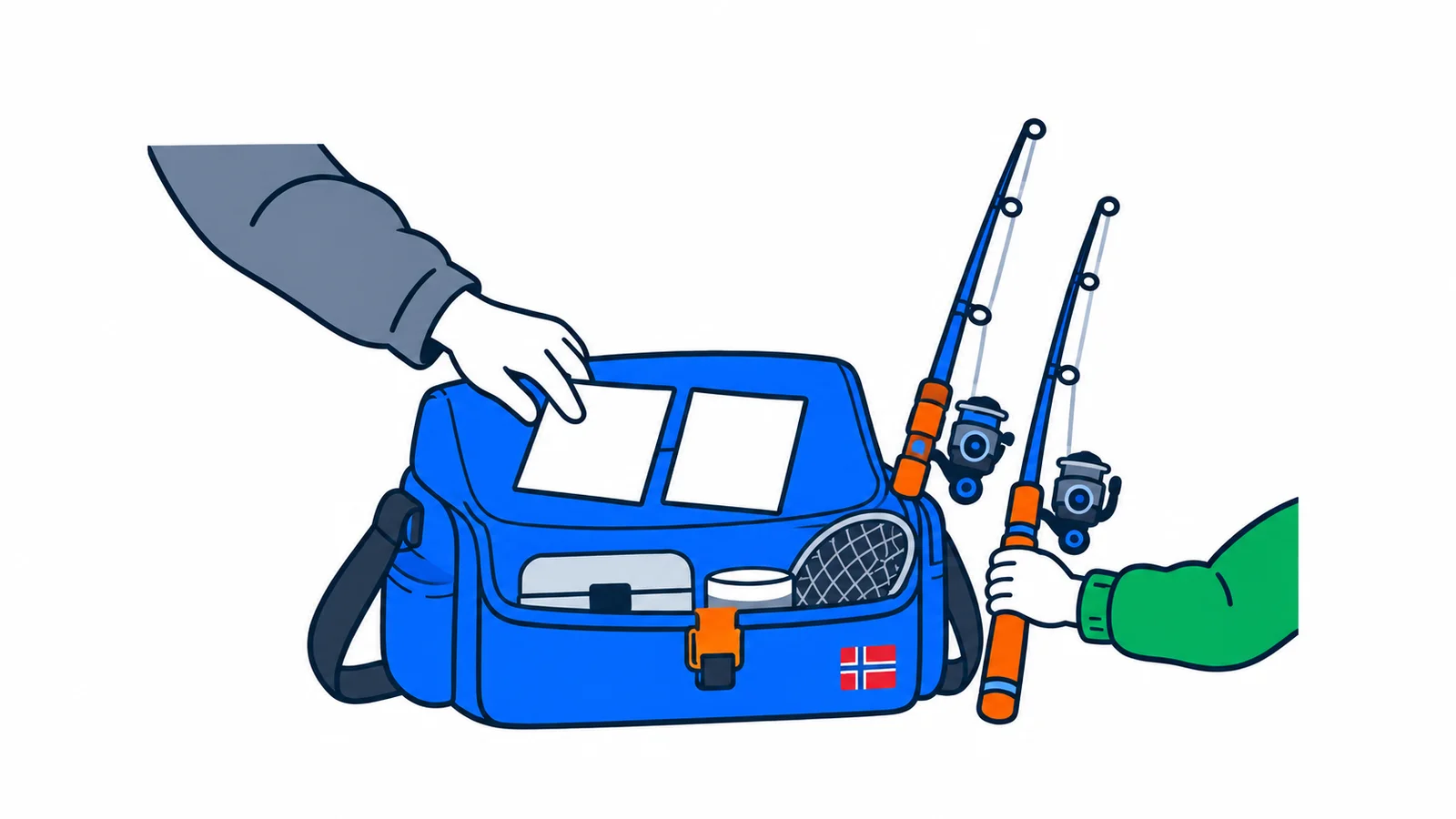

Is your family going freshwater fishing? First establish who holds the fishing rights and which rules apply to the water. A fishing permit is local permission. The national fishing fee is a separate state fee for specific types of fishing. Children have their own exemptions, but not in every body of water.
Do you need a fishing permit, the national fishing fee or both?
For ordinary fishing for inland fish, adults normally need permission from the holder of the fishing rights, often through a fishing permit. The national fishing fee is payable in addition for certain types of salmon fishing. The rules here were checked on 7 October 2026.
A fishing permit covers a specific area and period. The national fishing fee is paid to the state and gives no right to fish in a particular body of water. This distinction follows from lakse- og innlandsfiskloven, the Salmonids and Freshwater Fish Act, §§ 16–18 and 30.
| Planned fishing | Local permission | National fishing fee |
|---|---|---|
| Adult fishing for inland fish in water without anadromous salmonids | Normally a fishing permit or other permission | No |
| Person aged 18 or over fishing for salmon, sea trout or sea-run Arctic char in a watercourse | A fishing permit or another valid fishing right | Yes |
| Child under 18 fishing in a salmon river | Permission must be clarified; the free right for under-16s does not apply here | No |
Inland fish include trout and Arctic char that live in freshwater. Anadromous salmonids migrate between the sea and freshwater, such as salmon, sea trout and sea-run Arctic char. Ask the permit seller what type of watercourse and stretch you have chosen.
The right to walk along the water does not mean you may fish there. Read about access and consideration for others in SamfunnPrep's guide to the right to roam.
Can children under 16 fish for free?
Yes, children who have not yet turned 16 have a limited right to fish for inland fish free of charge. Under lakse- og innlandsfiskloven § 18, this applies:
- using a rod and handline
- from 1 January through 20 August, inclusive
- in watercourses covered by this right.
If the holder of the fishing rights issues permits, the child is entitled to a free fishing permit. Therefore obtain the permit from the seller. In other watercourses covered by the rule, the child may fish without the rights holder's permission during the same period.
The right does not apply in watercourses or stretches with anadromous salmonids, in artificial ponds or to crayfish. Nor does it override conservation measures and other fishing rules. The authorities may also regulate children's fishing when it harms measures for fish stocks or substantially displaces fishing by the rights holders.
After 20 August, clarify the child's permission and any price with the permit seller. A child's free fishing right does not give the adult the same right. If you intend to fish yourself, you must have your own permission.
How do you buy the correct fishing permit?
First find the name of the lake or river and who sells permits for it. Miljødirektoratet, the Norwegian Environment Agency, describes both online purchases and local sellers, such as landowners' associations, mountain boards and shops, in its guidance on buying fishing permits.
You can find permits through services including Inatur. Search for the correct area and read the offer before paying. With Inatur, the receipt you receive by text message or email is valid as your fishing permit.
Check these points before buying:
- Does the map cover exactly the lake and the part of the river you intend to use?
- Does the permit cover the correct person, date and period?
- Which species and fishing gear are permitted?
- Does the child need a separate free permit or other permission?
If you cannot find a permit, ask the landowner or local manager. The absence of an online offer does not mean fishing is unrestricted. Keep the permit and the information about the rules.
When must you pay the national fishing fee?
Once you have turned 18, you must pay the national fishing fee to fish for salmon, sea trout and sea-run Arctic char in watercourses. The fee also applies to this fishing with fixed gear at sea, such as a bag net. Fishing with a rod or handline at sea is exempt from the fee under forskrift om utøving av fiske etter anadrome laksefisk, the regulations on fishing for anadromous salmonids, § 2.
For ordinary inland fishing, you do not need to pay this fee. However, Miljødirektoratet clarifies that you must pay when fishing for inland fish on a salmon-bearing stretch that is open for fishing for salmon, sea trout or sea-run Arctic char. Therefore clarify the stretch before choosing payment.
On the official payment page, the fee in 2026 is 347 kroner for one person and 554 kroner for a family. Family covers married or cohabiting couples, including any children aged 18 to 20, or single parents with children in the same age group. This does not replace local fishing permits.
The fee follows the calendar year. Pay before fishing, bring the receipt and show it during an inspection. A replacement for a lost receipt can be ordered through the official service.
How do you find open seasons and local rules?
Check the exact water where you will fish. A valid permit does not mean every species, type of gear or date is allowed. Inland fishing may also have local restrictions under innlandsfiskeforskriften, the inland fishing regulations, §§ 2–4.
For salmon fishing, use Miljødirektoratet's guide to Lakseregisteret, the Salmon Register to find the river and fishing season. Also read the permit seller's current rules. In particular, check:
- the opening date and last day of fishing
- zones where fishing is permitted or prohibited
- permitted bait, hooks and number of rods
- minimum sizes and how many fish you may keep
- catch reporting requirements.
Rules may change to protect fish. Therefore check updated information shortly before departure, even if you have already bought a permit.
What applies where the river meets the sea?
An exemption from the fee for sea fishing does not mean you may fish freely at the river mouth. The boundary between river and sea and specific protected zones determine the rules.
Forskrift om fiske etter anadrome laksefisk i sjøen, the regulations on fishing for anadromous salmonids at sea, § 3 establishes a 100-metre zone outside certain salmon watercourses. In this zone, rod and handline fishing from land may be permitted when the river is open for the relevant anadromous species; saltwater fish may be caught under the same conditions when the river is open for anadromous salmonids. Statsforvalteren, the County Governor, may have larger zones and stricter rules. Find the map and current rules for the location; do not assume every spot with saltwater is open.
What do you do with your catch and used equipment?
When fishing in salmon watercourses, you must report catches of anadromous salmonids to the fishing rights holder in the format and as often as they specify. Miljødirektoratet's reporting guide explains the information required, including location, time, number, weight and whether fish were killed or released. Also ask how to report a trip with no catch. Follow local reporting requirements for inland fishing.
Dry or disinfect equipment before changing watercourses. This also applies to boats and equipment that have been in the water. Areas with disease may have stricter requirements. Read the rules from Mattilsynet, the Norwegian Food Safety Authority, to prevent the spread of infection.
Do not move living or dead fish to another watercourse, or another part of the same watercourse, without the necessary permission. Do not use fish from another watercourse as bait, and never use living fish as bait. Gut and wash fish where you caught them, and empty water only into the watercourse it came from.
What should you check before the family's first trip?
Consider choosing a straightforward inland lake where the permit seller can explain the rules. Clarify the adult's and the child's permission separately, and save permits, receipts and contact information so you can find them during the trip.
Plan a safe fishing spot and supervise the children. Also see the guide to safety by the water. Take fishing line, hooks and other rubbish home. More practical resources are available in SamfunnPrep's tools overview.