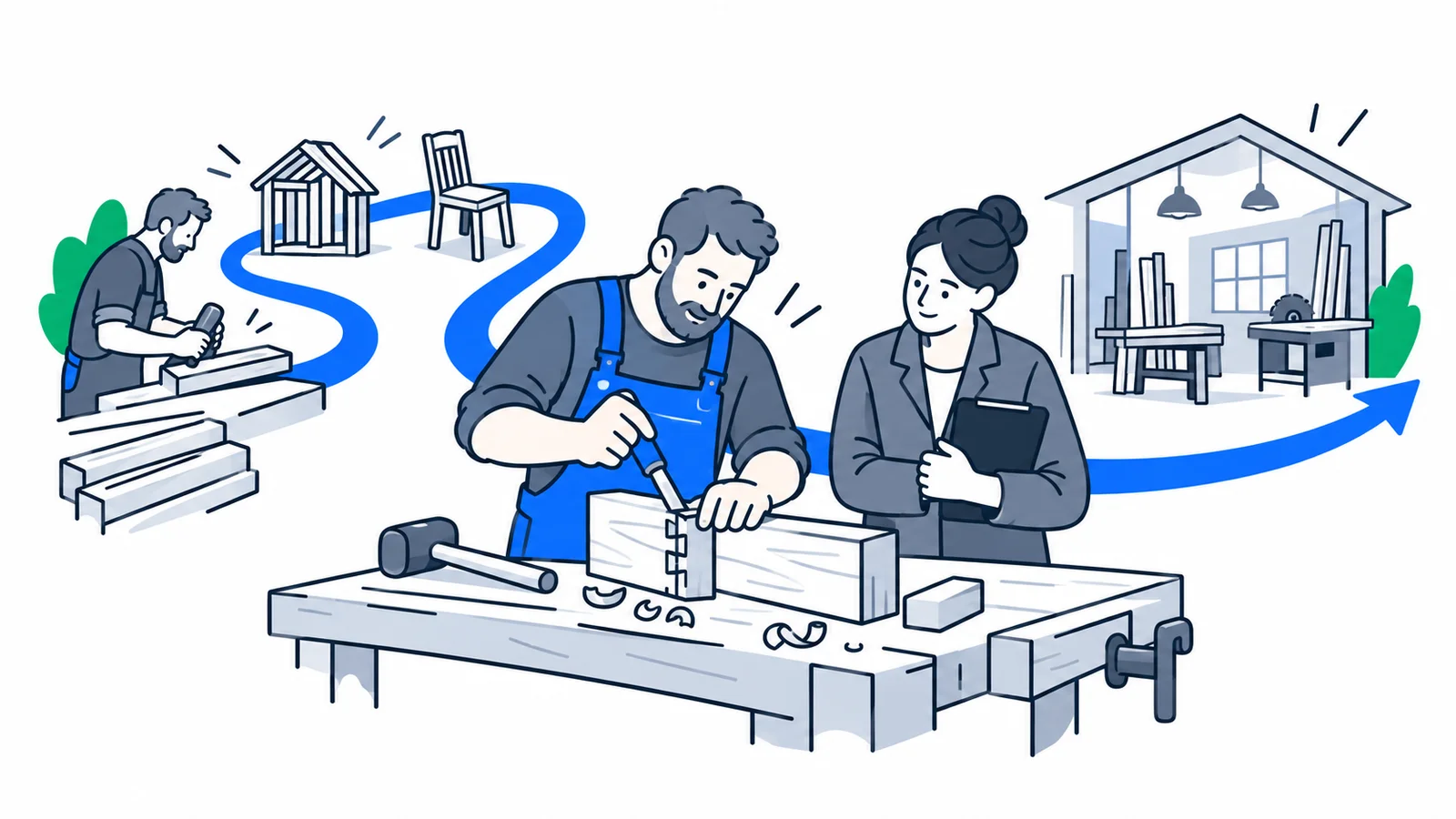

Do you have many years of work experience in a profession without formal qualifications? Then you can earn a vocational diploma without returning to school—through the apprenticeship pathway. This guide explains the 5-year rule, the trade test process, the Work-Based Diploma scheme, and how immigrants can leverage foreign work experience in 2026.
What is the apprenticeship pathway?
The apprenticeship pathway is established by Education Act § 4-3. It grants adults with sufficient and relevant work experience the right to take a trade test directly—without having completed upper secondary education in the field.
The scheme was introduced to recognize competence gained through work and give adults a fast route to a vocational diploma, while strengthening vocational competence in Norway.
The process in brief:
- You work in the field and collect documented experience (5 years)
- You register for the trade test with the county municipality
- You take a practical and/or theoretical trade test
- Pass = vocational diploma!
The scheme exists for most vocational professions in Norway—from construction to healthcare, technology, service, hospitality, electrical work, transport, and administration. See an overview at Udir.
The 5-year rule: how you document work experience
For most professions, at least 5 years of relevant full-time work experience is required—the well-known "5-year rule."
What counts as relevant work experience?
Work that matches the vocational competence objectives in the field. Examples:
- Want a diploma as a child and youth worker—experience in kindergarten, after-school programs, schools, or child welfare services
- Electrician—work at an electrical firm with equipment, installation, troubleshooting
- Chef—experience in restaurants, canteens, cafeterias, or large-scale kitchens
- Healthcare worker—home services, nursing homes, home care, or psychiatric care
Part-time work is calculated proportionally
The 5-year rule applies to full-time work. Part-time is converted to full-time years:
- 50% over 10 years = 5 full-time years
- 80% over 6.25 years = 5 full-time years
- 60% + 20% = 80% (combined)
Documentation requirements
The county municipality requires thorough documentation:
- Employment contracts showing the position's content and duration
- Employer verification of work performed, position percentage, and tasks
- Pay stubs or employer registration printouts confirming work periods
- Attestation from a qualified supervisor if available
For foreign experience: translated and certified documents. Court interpreters or authorized translators (see Domstol Administration) can assist.
The trade test: registration, conduct, and assessment
The trade test is organized by the county municipality in cooperation with industry organizations and labor market partners.
Step by step
- Apply to the adult education department at your county municipality.
- Documentation of 5 years' experience. Complete the form and attach verifications.
- County municipality assessment. They evaluate whether your experience is sufficient and relevant.
- Approval as an apprenticeship candidate. Written decision.
- Trade test scheduling. You receive information about time, place, and requirements.
- Practical trade test. Normally 8–48 hours depending on the profession. May span multiple days.
- Assessment. Two assessors evaluate the test—one employer representative and one employee representative.
- Vocational diploma issued. Within 3–6 weeks after passing the test.
Appealing the assessment
You can appeal the assessment result in writing within 10 days of notification. The county municipality handles the appeal.
Costs
- Test fee: NOK 0–1,500 (varies by county and profession)
- Materials: Profession-specific (tools, equipment)
- Courses: Optional preparatory courses may cost NOK 2,000–15,000
NAV support: The unemployed can get the test fee covered and course support. Contact your NAV advisor.
Adult right to upper secondary education and Work-Based Diploma
The adult right (§ 4A-3)
Everyone over 25 years old without completed upper secondary education has a right to free upper secondary education. See our detailed guide on the adult right to free upper secondary education.
This is an alternative to the apprenticeship pathway if you:
- Don't have 5 years' experience
- Want theoretical grounding before the trade test
- Need vocational specialization
Work-Based Diploma (§ 4-6)
Work-Based Diploma is a newer scheme where you earn your diploma while employed and working in the field. A combination of work and training over 2–3 years:
- Your employer covers wages and apprenticeship contract
- The county municipality organizes the theoretical component
- The trade test is taken after completing the training
The scheme suits adults already in relevant work who seek formal qualifications.
Comparison
| Scheme | Requirements | Duration | Cost |
|---|---|---|---|
| Apprenticeship pathway | 5 years' experience | Direct trade test | Test fee |
| Adult right to upper secondary | Over 25 years old | 1–3 years | Free |
| Work-Based Diploma | Employment | 2–3 years | Free (employer) |
Real competence assessment
Real competence assessment (RKV) evaluates what you already know based on work, education, and life experience. The county municipality can grant credit for parts of upper secondary education.
Relevance for apprenticeship candidates:
- If you have 3–4 years' experience, RKV can assess whether the remainder can be covered through short training
- Foreign vocational education can be credited via RKV and supplement Norwegian training
See also recognition of foreign education.
Special considerations for immigrants
Foreign work experience
Experience from your home country can be used if:
- Documentation is translated and certified
- The county municipality recognizes it as relevant and professionally equivalent
- The qualification is not already recognized as a Norwegian vocational diploma
Norwegian language requirements
Some professions require minimum B1 level Norwegian before the trade test—particularly in healthcare, service, and administration. Check with your county municipality. Can be combined with Norwegian training for adult immigrants.
Interpreter during the trade test
If you don't fully master Norwegian, you can request an interpreter for the oral and theoretical parts of the trade test. The practical part takes place in the workplace language of the profession.
Vocational diploma and residence
A vocational diploma strengthens applications for permanent residence—documented competence in the Norwegian labor market counts positively.
After the diploma: career and further education
With a vocational diploma, you can:
- Work independently in your profession with formal qualifications
- Take specialized education at a trade school (1–2 years)
- Pursue Y-track to higher education at university/college
- Become a technical supervisor or start your own business—see freelancer or sole proprietorship
- Participate in vocational diploma exchanges internationally
Professions with special rules
- Healthcare professions—may require authorization from the Norwegian Health Authority
- Electrician and other electrical trades—require DSB authorization
- Transport (professional driver)—YSK certificate required in addition
- Maritime—certificate from the Norwegian Maritime Authority
Summary
The apprenticeship pathway (Education Act § 4-3) allows adults with 5 years of relevant work experience to earn a vocational diploma directly via trade test without upper secondary school. Foreign experience can be used with translated documentation and county municipality approval. The test fee is NOK 0–1,500; NAV can cover costs for the unemployed. Alternatives include the adult right (§ 4A-3), Work-Based Diploma (§ 4-6), and real competence assessment. A vocational diploma opens doors to Y-track and trade school, strengthens permanent residence applications, and provides formal recognition of your work competence.