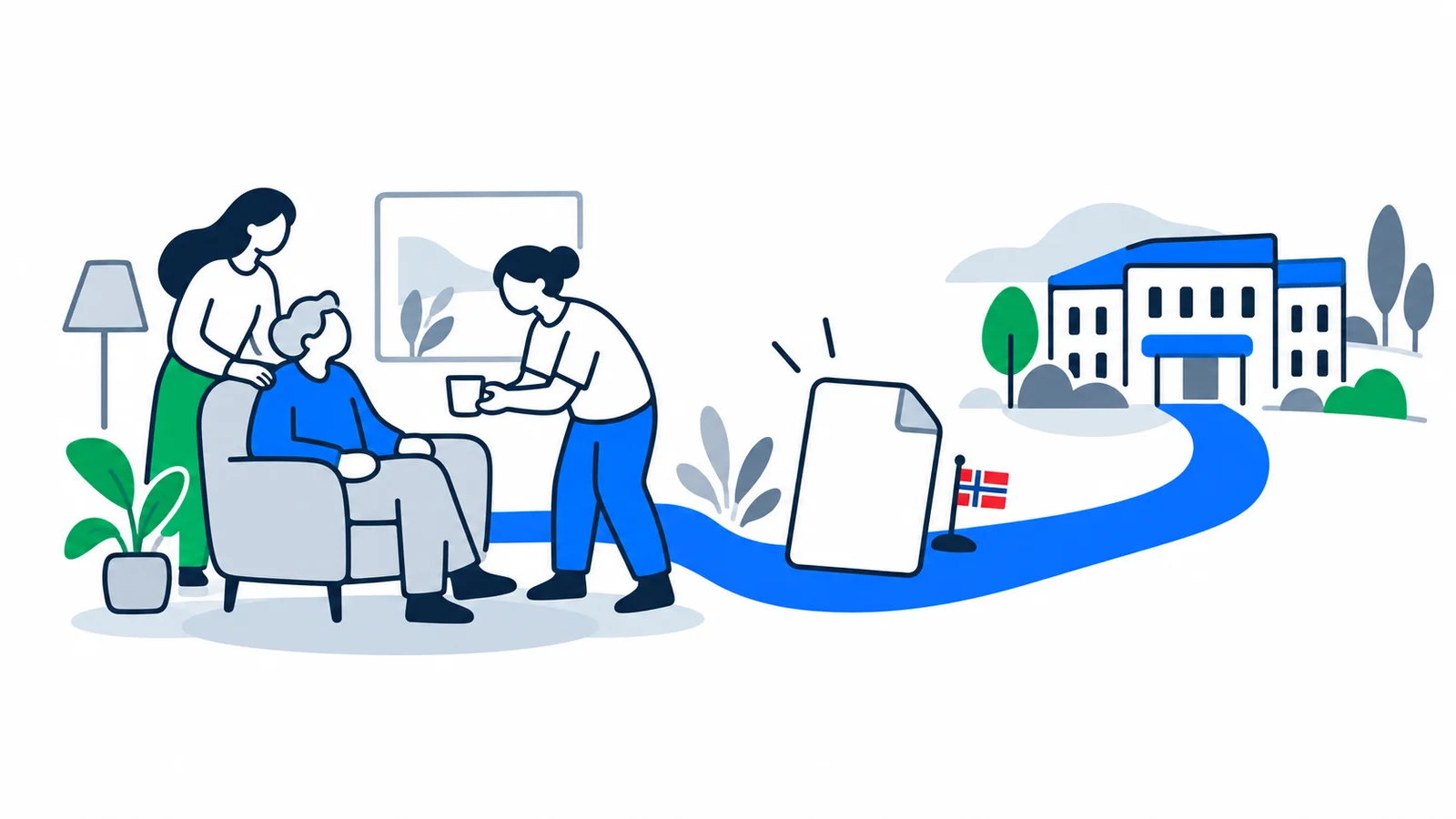

Elderly care in Norway is the responsibility of the municipality. You apply to the municipality, get a written decision and can appeal. Services are graduated from home help to nursing homes. Necessary care is a right, and most of it is financed by taxes with a low co-payment.
What is elderly care in Norway, and who is responsible?
Elderly care in Norway is a public responsibility. The municipality – the local authority where you are registered – must provide health and care services to everyone who needs them. This is set out in the Health and Care Services Act.
You do not need to be a Norwegian citizen to get help. Necessary care is a right under the Patients' and Users' Rights Act. The right applies regardless of your background, as long as you live legally in the municipality.
Services are mainly financed by taxes. You pay a co-payment, but it is low and depends on your income. Your family has no legal duty to care for elderly relatives. If you want to help anyway, the municipality can give you care allowance – read more about care allowance and home care.
The care ladder: from home help to nursing homes
Norwegian elderly care is built as a care ladder. You get help at the lowest level that meets your needs. The aim is for you to stay at home as long as possible.
| Level | Service | What it provides |
|---|---|---|
| 1 | Practical assistance (home help) | Help with cleaning, laundry and shopping |
| 2 | Home nursing care | Medicines, wound care and personal care at home |
| 3 | Safety alarm and day centre | Alarm for falls; activity and meals during the day |
| 4 | Care housing | Your own adapted home with services nearby |
| 5 | Nursing home (long-term placement) | Full-time care when the need is great |
The municipality always assesses your individual need. Many manage for a long time with home nursing care and a safety alarm. A nursing home place is given when you need close monitoring around the clock.
There is an important difference between care housing and a nursing home. A care housing is your own home, where you pay rent and get services as needed. A nursing home is an institution where care, meals and medicines are included, and you pay one combined co-payment.
If you need a lot of help but want to stay at home, there is also user-controlled personal assistance (BPA). You then choose who helps you and when. The municipality decides if you have the right to this scheme.
How do you apply for care services in the municipality?
You apply to the municipality for help. Most municipalities have a separate application office or "allocation office". You can also get help to apply via Helsenorge (the public health portal) or by calling the municipality.
Here is how it works:
- You send an application and describe your needs.
- The municipality assesses your needs, often with a home visit.
- You get a written decision that says yes or no, and what you get.
- If you disagree, you can appeal within the deadline in the decision.
You send the appeal first to the municipality. If the municipality does not change the decision, the case is sent to the Statsforvalteren (the state's regional authority), which makes the final decision. The appeal is free. If you need support, the Patients' and Users' Ombudsman can help you free of charge.
The municipality cannot say no just because the service is expensive. The decision must be based on an individual assessment of your needs. If you get a decision you do not understand, you have the right to ask for an explanation. If your health changes, you can apply again at any time.
What does elderly care cost? Co-payment and income
The co-payment for elderly care in Norway is income-dependent, and no one should pay more than the service costs the municipality. Two rules are important to know.
For practical assistance (home help), there is a cap for those with low income. If the household has a net income below 2G (twice the National Insurance basic amount), the municipality can charge a maximum of 245 kroner per month (as of 2026). Home nursing care and other necessary health help at home is free.
For long-term stays in nursing homes, you pay a share of your income, not a fixed price:
- 75 percent of income up to 1G.
- Up to 85 percent of income above 1G.
- You get an exemption of 10 950 kroner (as of 2026) and always keep at least 25 percent of 1G for your own use.
The basic amount (1G) is 136 549 kroner from 1 May 2026. Your assets – such as a house, cabin or bank savings – do not count. Only ongoing income, such as a pension, counts. The co-payment for a long-term place is first required one month after moving in.
A short stay in a nursing home, called a short-term stay, is paid with a fixed daily rate set by the state. If your spouse lives at home, the municipality takes this into account so the family has enough to live on. If you are unsure about the bill, ask the municipality for a written calculation.
How can immigrant families get help?
You have the right to an interpreter when you are in contact with the municipality or the health service. The interpreter is free and is bound by confidentiality. Ask for an interpreter before the meeting so that language does not become a barrier to good care.
The municipality must give you information you understand. Feel free to bring a relative to the application meeting. You can also read more about the Norwegian health system and about health rights and social security to understand what you are entitled to.
Elderly care is closely linked to pensions. A pension is often the income that the co-payment is calculated from, and residence in Norway affects how much pension you receive. See how this works in the article about pensions, residence and contributions.
Welfare and health are part of the syllabus for the Citizenship Test. With SamfunnPrep you can practise for free on exactly these topics, while learning about the rights that apply to you and your family. Many use SamfunnPrep to prepare safely and at their own pace.