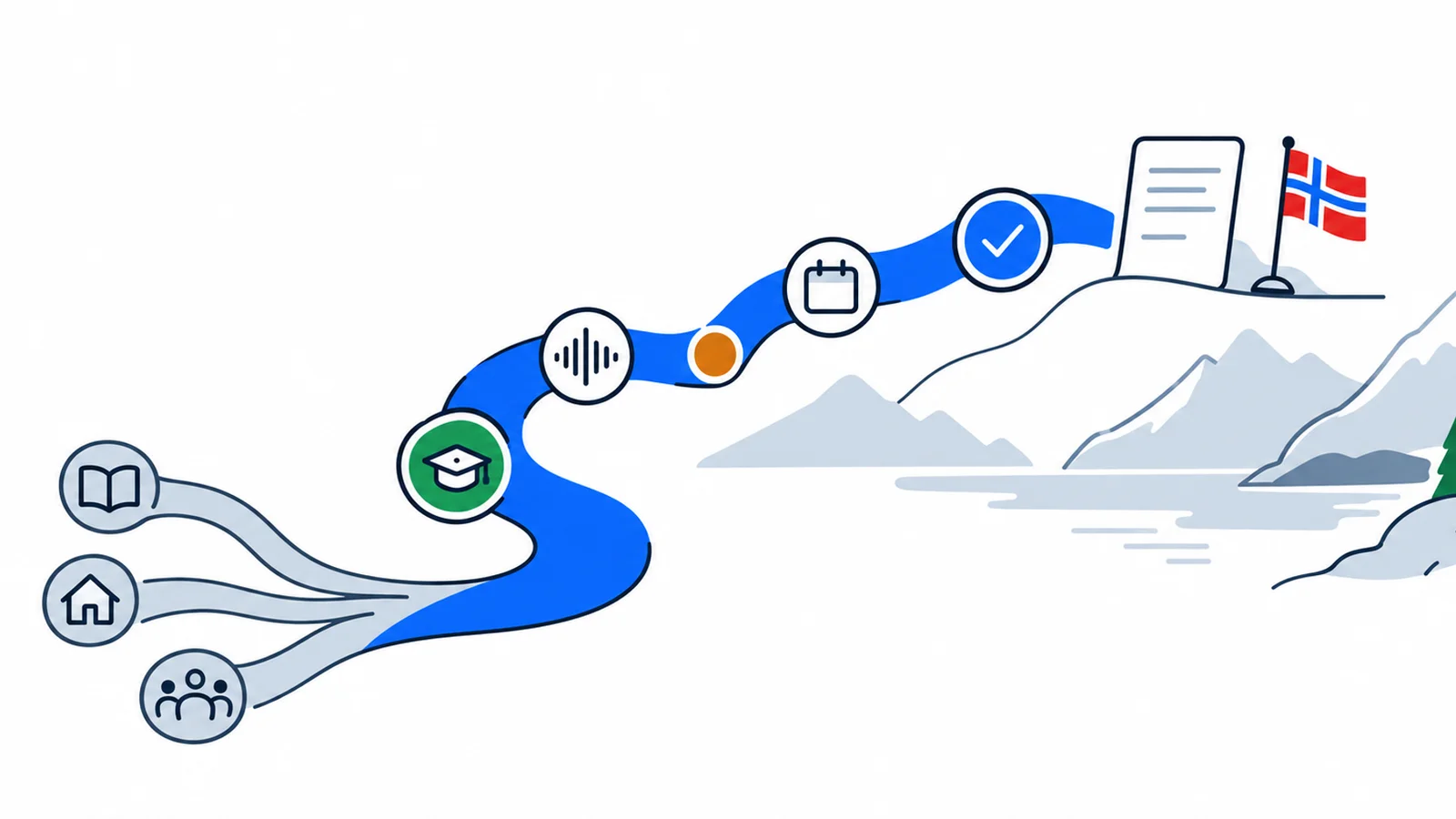


Becoming a Norwegian citizen typically requires eight years of residence in Norway, approved Norwegian language level, passing a civics exam or citizenship exam, and the citizenship law changes in 2026.
How many years must you have lived in Norway?
The main rule for residence is that you must have lived in Norway for a total of eight of the last eleven years, with residence permits of at least one year at a time. The requirement applies to applications with the UDI (Directorate of Immigration), and you should check the current requirements with the UDI, since the rules may change in 2026.
In addition, you must have permanent residence permit, or meet all the conditions for permanent residence, when the UDI processes your application. Shorter periods abroad, for example holidays, typically do not count towards your residence time as long as you still have a valid permit and permanent residence in Norway.
The residence requirement is shorter for several groups:
- Refugees: a total of seven years of residence within the last ten years.
- Spouse, partner or cohabitant with a Norwegian citizen: five years of residence, and residence plus cohabitation totalling at least seven years.
- Stateless persons: their own, shorter residence requirement that may change in 2026 (check with the UDI).
- Self-sufficient persons with good own income and tax settlement: six years within the last ten years.
If you are uncertain which group you belong to, you can calculate your own residence time on the UDI's pages or ask for guidance there. You can start practicing the civics exam with SamfunnPrep while you are accumulating residence time, so you are ready the day you can actually apply.
What Norwegian language level do you need?
You must pass an oral Norwegian language test at level B1 to become a Norwegian citizen. The requirement was tightened from A2 to B1 in 2022, and there has been political debate about raising the level further to B2 — read more about current Norwegian language requirements for citizenship before you plan your application, since this may change.
Some groups can use level A2 instead of B1, including people over 55 years old who arrived as refugees or reunited family members, people receiving disability benefits, and certain stateless applicants. Children under 18 years old and adults over 67 years old are generally exempt from the requirement for a language test and civics exam.
You document your Norwegian language level with an official, approved test, such as Norwegian Language Test, or with other documentation that the UDI accepts, for example completed Norwegian language training at the appropriate level. Keep all course certificates and test results, as you must attach them to your application.
Civics exam or citizenship exam
You must also pass the civics exam in Norwegian, or the citizenship exam, which tests your knowledge of Norwegian history, democracy, values and society. The citizenship exam has 36 tasks with three answer options, and you must answer at least 24 correctly to pass.
The two exams cover approximately the same curriculum, but have slightly different language levels and slightly different target groups. Many who have attended introduction programs have already taken the civics exam as part of their training, while the citizenship exam is specifically designed for citizenship applications.
SamfunnPrep has practice tasks that resemble the real exams, with explanations for each topic. This way you know what you already understand, and what you should read more about before you register for the exam.
Good conduct and waiting period
You must have good conduct to become a Norwegian citizen, meaning you are not convicted or charged with serious crimes. The UDI checks your conduct through a police certificate and also obtains information from other public registers if needed.
If you are convicted of a punishable act, you may have a waiting period — a period you must wait before you can become a citizen, even if you otherwise meet all other requirements. The length of the waiting period depends on how serious the crime was and what sentence you received (check with the UDI for your case). Less serious matters generally result in a shorter or no waiting period.
Can you have dual citizenship?
Yes. Since January 1, 2020, you can retain your previous citizenship when you become Norwegian. Before 2020, most applicants had to renounce their previous citizenship to become Norwegian, but that is no longer the case.
You therefore usually do not need to renounce the citizenship of your home country, unless the laws of that other country require it. Dual citizenship makes it easier to maintain ties with family, inheritance and rights in your home country, while gaining full rights as a Norwegian citizen, including the right to vote and a Norwegian passport.
How does the UDI process your application?
You apply for citizenship digitally to the UDI and submit documentation of identity, residence, Norwegian language skills and exam results. There is usually a fee to apply, and the amount changes from time to time, so check the correct amount on udi.no before you pay.
Processing time varies considerably from case to case, depending on how complete your application is and how many cases the UDI has to process. The UDI may request additional information during the process, and you can follow the status of your application on your UDI portal throughout.
Citizenship ceremony
When your application is approved, you officially become a Norwegian citizen from the decision date — you do not need to wait for the ceremony for citizenship to take effect. Many counties still invite new citizens to an annual citizenship ceremony, where you celebrate with others who have just become Norwegian.
The ceremony is voluntary, but a nice way to mark that you now have the same rights and responsibilities as other Norwegian citizens, including the right to vote in parliamentary elections and the right to a Norwegian passport.
Citizenship law changes in 2026
In 2026, the government has sent proposals for amendments to the citizenship law for public consultation, including how residence time should be calculated, stricter residence requirements for stateless applicants, and simplified rules for spouses and partners of Norwegian citizens. The proposals have not been passed yet.
Read more about changes to the citizenship law in 2026, and always check the current requirements with the UDI before submitting your application, as the rules may change during the year.
Ready to practice? Try SamfunnPrep for free and practice the civics exam and citizenship exam at your own pace.