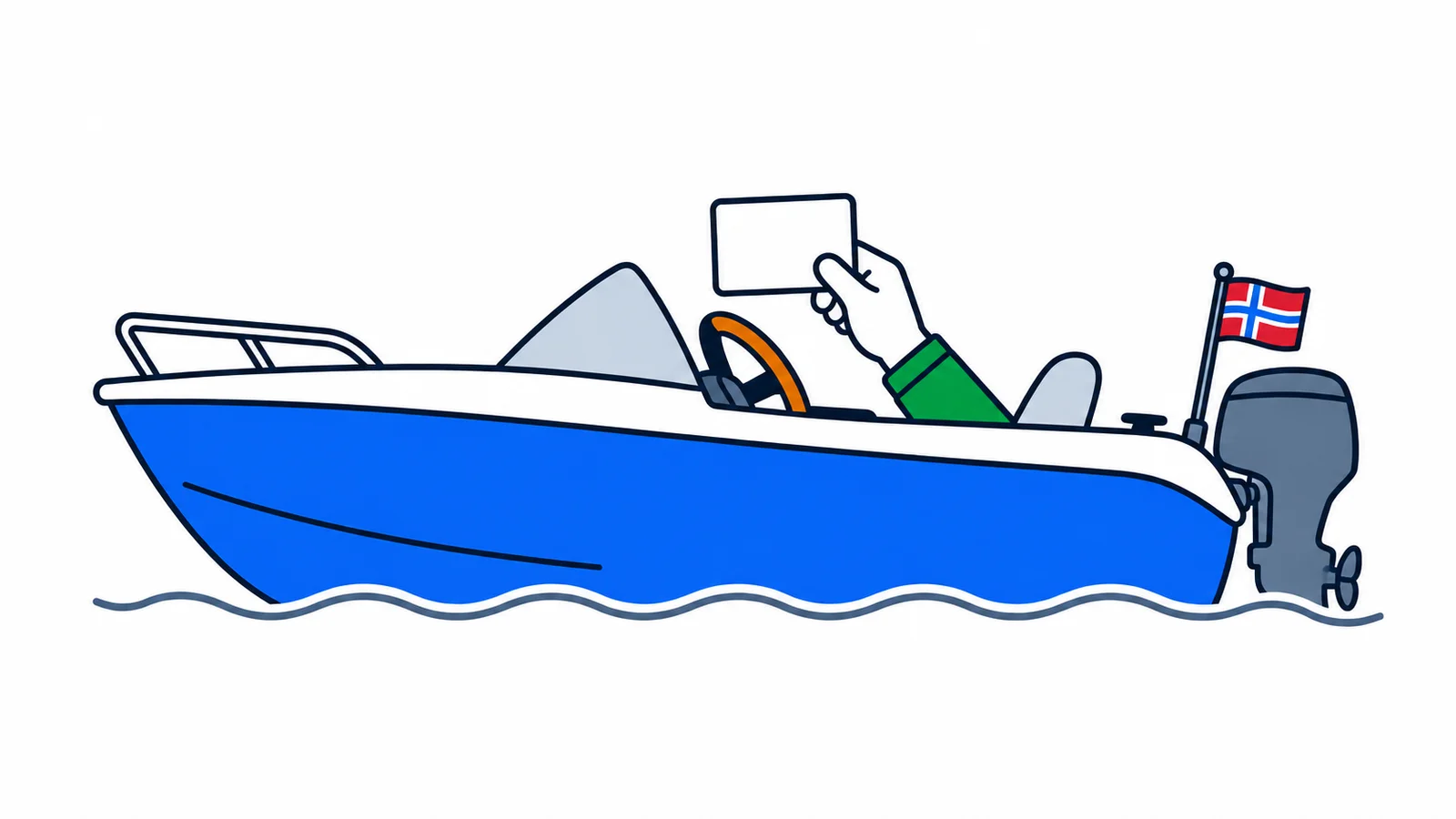

You need a boating licence or another valid qualification if you were born on or after 1 January 1980 and the boat is over 8 metres long or has more than 25 hp. Foreign certificates must meet separate conditions. Boats capable of 50 knots or more also require a high-speed certificate.
The rules below were checked on 7 October 2026. They apply to Norwegian recreational boats in Norway. The abbreviation hp means horsepower, and kW means kilowatts. Sjøfartsdirektoratet, the Norwegian Maritime Authority, administers the certification rules. Norsk Test AS conducts the boating test and issues boating licences on behalf of the authority.
When do you need a boating licence?
If you were born on or after 1 January 1980, exceeding either limit is enough: over 8 metres or more than 25 hp. You need a boating licence or another valid qualification certificate for such a boat with a hull length below 15 metres.
| Situation | Limit or requirement |
|---|---|
| Under 16 years old | Without your own certificate, you may operate a boat up to 8 metres long with no more than 10 hp (7.5 kW) |
| At least 16, born on or after 1 January 1980 | Without a certificate: up to 8 metres and no more than 25 hp (19 kW) |
| Born before 1 January 1980 | Exempt from the boating licence requirement for boats under 15 metres |
| Boat capable of 50 knots or more | A high-speed certificate is required in addition to the other requirements |
A 7-metre boat with 30 hp therefore requires a certificate for a driver born in 1990. So does a 9-metre boat with 20 hp. A boat exactly 8 metres long with 25 hp falls within both limits for operation without a certificate from age 16.
What counts is the hull length, rather than the length including all additional equipment. The owner and driver are responsible for ensuring that the driver meets the requirements. See the regulations on requirements for recreational boat operators, §§ 2, 3, 5 and 7.
From 15 metres upwards, a boating licence alone is insufficient. A recreational skipper certificate is required, including for people born before 1980. This guide covers ordinary recreational use, rather than commercial boat operation.
Is your foreign boating certificate valid?
A certificate from another EEA state is valid in accordance with what it covers. EEA means the European Economic Area. Check which boat types and limits your certificate actually covers.
Other foreign boating certificates must meet two conditions: the certificate must broadly satisfy Norwegian requirements and must have been issued in a Scandinavian language or English. An International Certificate of Competence (ICC) under Resolution 40 of the United Nations Economic Commission for Europe must cover coastal navigation to be valid in Norway. See §§ 13 and 15a of the regulations.
If in doubt, you can request confirmation from post@sdir.no or bat@norsktest.no. Sjøfartsdirektoratet explains foreign certificates.
A practical suggestion is to send:
- a photo of both sides of the certificate
- the issuer's name and the country that issued the certificate
- the boat's hull length, engine power and possible top speed
- a question asking whether the certificate covers this particular boat.
Exchanging it for a Norwegian certificate is a separate matter from its validity. Under § 14, the foreign certificate must have been issued while you lived in the issuing country. You must have resided there for more than one year. Contact Norsk Test about the application; do not expect an automatic exchange.
When do you need a high-speed certificate?
For Norwegian motor-powered recreational boats under 24 metres, a high-speed certificate is required if the boat can reach 50 knots or more. Planning to drive more slowly makes no difference. The requirement also covers personal watercraft and applies even if you were born before 1980.
The certificate does not replace your underlying entitlement to operate the boat. You must be 18 to have it issued. You can take the course from age 17; it includes theory and practice. The certificate covers either boats or personal watercraft. See §§ 17a–17c of the regulations.
A speed-limiting key for a personal watercraft does not remove the requirement. Recognised foreign high-speed certificates are normally used only during temporary stays, such as tourism. If you live permanently in Norway, you must have a Norwegian high-speed certificate. Read Sjøfartsdirektoratet's guidance on high-speed certificates.
How do you take the boating test?
Register in Båtførerregisteret and arrange a test at an approved test centre. A course before the boating test is optional. A preparatory course is not approved by Sjøfartsdirektoratet, even if the test centre is approved.
Båtførerregisteret, the boating certificate register, is run by Norsk Test. Do the following before the test:
- Register and pay the test fee.
- Use the list of test centres and arrange a time.
- Read the candidate information and check the photo and identification requirements.
- Ask the test centre beforehand if you need language assistance or accommodations.
The test fee is 940 kroner as of 7 October 2026. It covers one attempt and issuance of the certificate. Any course costs extra. You can take the boating test from age 14, but the certificate is issued only from age 16. After failing, you must wait at least 14 days before another test.
The test is electronic, with 50 questions in one hour. You must answer at least 80 percent correctly overall, meaning no more than 10 errors. In the section on “particularly important topics”, you may make no more than two errors. More errors in that section mean a fail even if your overall result is good.
Let the centre know before signing up if you need accommodations. An additional 20 minutes may be granted. In special cases, Norsk Test may allow an oral test following an application. See the information about the boating test.
Can you practise before receiving your certificate?
Yes, under the supervision of an instructor or accompanying person who meets the requirements in § 19. That person must be entitled to operate this particular boat and must at least meet the requirements for operating a boat that requires a boating licence. Having just any adult beside you is insufficient.
The instructor or accompanying person is considered the driver during practice. Speed, weather and traffic conditions must be safe. You cannot practise while subject to a disqualification period or if you have lost your entitlement to operate a boat or had it revoked. Read the regulations on practice driving.
What do you do if your certificate is lost?
Apply for a duplicate through Min Side in Båtførerregisteret. If you have no profile, you must register first. A duplicate costs 531 kroner as of 7 October 2026.
You must be able to show a valid certificate during an inspection. Boating licences and ICCs are still plastic cards and are not available in the certificate app. Contact Norsk Test if you are unsure about your registration. See Båtførerregisteret's information about lost certificates and § 20 of the regulations.
Do you need an ICC when renting a boat abroad?
That depends on the country and the rental company. ICC, International Certificate of Competence, is an international boating certificate. A Norwegian boating licence is not always sufficient, and an ICC is not automatically accepted everywhere either.
If you apply for a Norwegian ICC based on the boating test, you also need a practical test and a health self-declaration. You must be at least 16. If you reside in Norway, you meet the nationality or residence condition. The practical test with an approved provider determines whether the certificate covers motorboats, sailing boats or both. Some higher maritime certificates provide another basis for applying. Sjøfartsdirektoratet may require a medical certificate if there is reason to doubt your health.
Contact the authorities in the country and the rental company before booking. Also check the rules of the country where the boat is registered. Read Sjøfartsdirektoratet's ICC guidance.
Have new requirements been introduced in 2026?
A proposal is not a rule already in force. On 3 February 2026, Sjøfartsdirektoratet proposed a practical component in the boating test and lowering the high-speed threshold to 45 knots. As of 7 October 2026, the current regulations still specify a theory test and 50 knots. See the proposal from February 2026.
SamfunnPrep also has guides to the right to roam and water safety. You can find other practical resources in SamfunnPrep's tools overview.