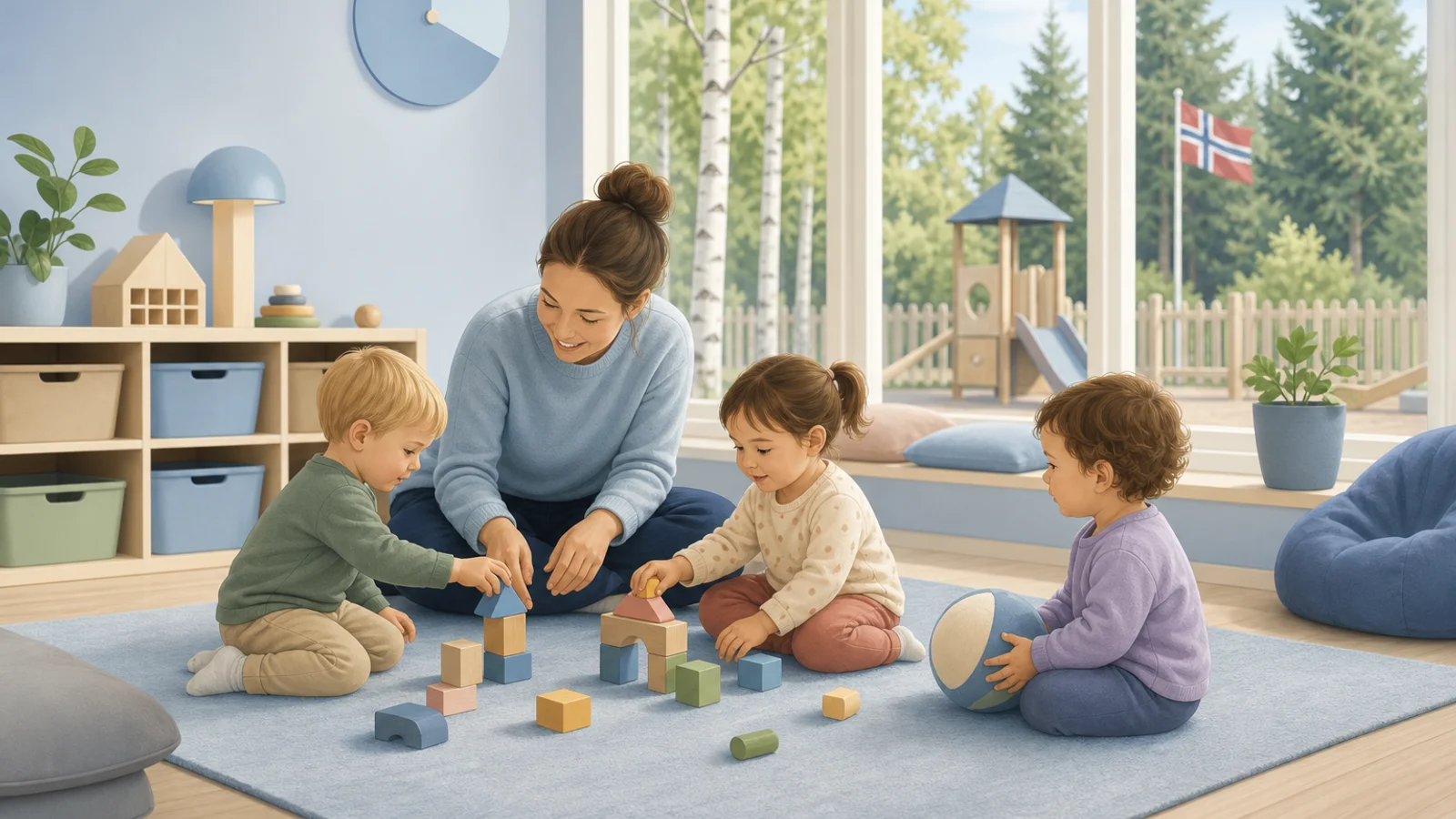


Open kindergarten is a free or inexpensive meeting place where you come together with your child, without applying for a place. You stay with your child the entire time, you play and sing together, and you meet other parents.
What is open kindergarten?
Open kindergarten is an educational offering where parents are together with their children in the kindergarten. Children play and participate in activities with other children, while you yourself are present.
Udir (Utdanningsdirektoratet) describes the offering as a supplement to regular kindergartens. It lies outside the ordinary kindergarten offering in the municipality. The framework plan, the regulation about what kindergartens should do, also applies here. But it must be adapted to the way open kindergartens are run.
The offering is suitable for you if you are on parental leave, waiting for a kindergarten place, do not want a place, or wish to delay kindergarten start. Many also use it to get out of the house and build a network when you are new to Norway.
Do I need to apply for a place in open kindergarten?
No. There is no application, no registration, and no fixed place. You show up within opening hours, and you can come as often and for as long as you want, according to SSB (Statistisk sentralbyrå).
The municipality has no obligation to offer open kindergarten, but it can choose to do so. The municipality also cannot use open kindergarten to fulfill your right to a kindergarten place, Udir emphasizes.
If you want a regular place, you must apply for it separately. This is explained in the article about applying for a kindergarten place: admission, deadline, and cost.
You do not register, and you do not receive any written response from the municipality. If you are unsure whether you can come, call or email the kindergarten in question.
What does open kindergarten cost?
The offering is often completely free. In some places, parents pay a low amount per visit, according to Udir.
There is no maximum price and no application for reduced payment, as there is in regular kindergarten. The price is determined locally, so ask where you live.
A typical morning
A day in open kindergarten is calm and predictable. Oslo municipality describes, for example, Furuset open kindergarten like this:
- Free play. Oslo municipality calls it a play and activity offering for children of kindergarten age together with an adult.
- Singing time at a set time, at 12.00 or 12.15, with separate days for the youngest.
- Story time together with the library.
- Packed lunch from home. The kindergarten does not serve food, but you can borrow a microwave, kettle, cups, and cutlery.
- Visits from professionals, for example a physiotherapist from the health station.
- On-site help with applying for regular kindergarten and information about other services in the district.
The offering at Furuset is free, according to Oslo municipality. The facility has room for 15 families at the same time, and the kindergarten is usually closed in July. Other places have different hours. Check the website of the open kindergarten where you live.
Open kindergarten or regular kindergarten?
The biggest difference is who looks after your child. In open kindergarten, you stay with your child; in regular kindergarten, the staff take responsibility.
| Question | Open kindergarten | Regular kindergarten |
|---|---|---|
| Do you need to apply? | No, you show up during opening hours | Yes, you apply for a place with the municipality |
| Fixed place? | No, no one has a fixed place | Yes, your child has their own place |
| What does it cost? | Often free, or a low amount per visit | Parental payment up to a maximum price |
| Who looks after your child? | You, who are there all the time | The staff, while you are away |
| Opening hours | A few hours on set days | Full day, all weekdays |
The adults who accompany the children count as part of the staffing (SSB). The pedagogue ratio, the requirement for a certain number of children per pedagogical leader, does not apply to open kindergartens, Udir writes. The staffing must still always be appropriate, and approved private open kindergartens must have a manager.
How many open kindergartens are there?
As of 4 August 2026, 106 open kindergartens were marked as active in Utdanningsdirektoratet's national kindergarten register. Of these, 67 are private and 39 are public. In total, 117 facilities fall in the category.
The offering is unevenly distributed. Vestland has 19 active, Rogaland 16, Trøndelag 14, Oslo 13, and Akershus 12. Innlandet and Finnmark have none registered at all. Note that open kindergartens with opening hours of less than 20 hours per week are not required to apply for approval under the kindergarten law § 6. The actual number of meeting places is therefore likely higher than the register shows.
The number of facilities has remained nearly static. Udir counted 105 open kindergartens in 2021. Capacity, however, has been cut in half. SSB reported in 2023 that the number of children who can be present at the same time fell from 6,700 in 2003 to just over 3,600 in 2022. At the same time, ownership shifted: in 2003, 62 percent of places were public; in 2022, 71 percent were private.
Why does this matter for new families?
Open kindergarten fills the gap before your child gets a place. IMDi (Integrerings- og mangfoldsdirektoratet) reported in September 2025 that 66 percent of children with minority languages as their first language aged one attended kindergarten in 2024. Among one-year-olds with Norwegian, Sámi, Swedish, Danish, or English as their mother tongue, the share was 89 percent.
Udir writes that open kindergarten can recruit for regular kindergarten, act preventively, and help reduce social inequalities. Parents get in contact with other parents, and children get play and friendship.
You do not need to speak Norwegian well to come. The staff have contact with parents throughout the opening hours. If you are new to the country, the checklist for your first week in Norway from SamfunnPrep is a good place to start.
How to find an open kindergarten near you
Start with your municipality. These approaches work:
- Search online for "open kindergarten" and your municipality name.
- Look for family house or family center. Many municipalities have open kindergarten in the same building as the health station.
- Look it up on barnehagefakta.no, Udir's own overview. It only shows registered kindergartens.
- Ask at the health station for children 0–5 years. The health nurse knows what is available where you live.
- Check with congregations and parent associations. Nearly two of every three active open kindergartens are private, 67 of 106.
Other free meeting places
If your municipality does not have an open kindergarten, there are other free places to meet people:
- Health station. Many health stations have postnatal groups where you meet parents with children of similar age.
- Volunteer centre. Norwegian Volunteer Centres report 571 centres spread across 337 municipalities. They are meant to be open meeting places for everyone. Find yours on frivilligsentral.no.
- Library and language café. Free to visit, with a children's section and books in over 50 languages.
- Home-Start Familiekontakten. A volunteer comes to your home once a week for two to four hours, for about six months. Free, for families with at least one child under school age.
- Red Cross. Refugee guide, women's groups, and Norwegian training. The offering varies between local chapters.
- Caritas resource centre. Free counselling, often in your own language, legal aid from lawyers, and Norwegian training. There are centres in, among others, Oslo, Bergen, Stavanger, Drammen, Arendal, Sandefjord, Hønefoss, and Tromsø.
Open kindergarten gives your child play and you adults someone to talk to. Do you want to practice Norwegian and civics knowledge at home too? Try SamfunnPrep free and train a little every day.