
Winter tyres are mandatory in Norway when road and weather conditions require them, but the law sets no fixed date – tyres only need to have at least 3 millimetres of tread depth. Spiked tyres, however, have fixed dates, and in several cities you must pay a spiked tyre fee or risk a fine.
What does the law say about winter tyres?
There is no set calendar date that says "now you must have winter tyres" in Norway. The law instead requires that your car always has tyres suitable for weather and road conditions, whether that is ice, snow or wet asphalt.
Statens vegvesen (the agency that manages Norwegian roads and sets requirements for vehicles) is clear that responsibility lies with you as a driver. In practice, this means that most people switch to winter tyres during October, before the frost truly sets in. If you have recently bought a car in Norway, tyres are one of the first things you should check.
The rule also applies if you drive with a trailer in winter. The trailer's tyres must then have tread depth as good as the car's own tyres.
Inspections by the police and Statens vegvesen most often occur in October and November, when many people are still driving on summer tyres. If you live in Southern Norway, frost may come later than in Northern Norway, but the requirement for adequate tyres applies equally throughout the country.
How many millimetres of tread must a winter tyre have?
Winter tyres must have at least 3 millimetres of tread depth. Summer tyres can have as little as 1.6 millimetres, but that is not sufficient in winter.
You can measure tread depth with a tread depth gauge from a tyre shop, or use a 20-krone coin as a rule of thumb. If the coin sits deep within the tread, the tyre is probably adequate. If the tread is worn flat, you should replace the tyres before winter truly sets in.
Remember that age also matters. The rubber in old winter tyres becomes harder and provides less grip, even if the tread looks adequate. Many people choose to replace tyres every five to six years.
Tyres with uneven wear on all four wheels are not advisable either, as grip then becomes uneven from side to side. Therefore check all four tyres, not just the two you see first when you park.
When is it permitted to use spiked tyres?
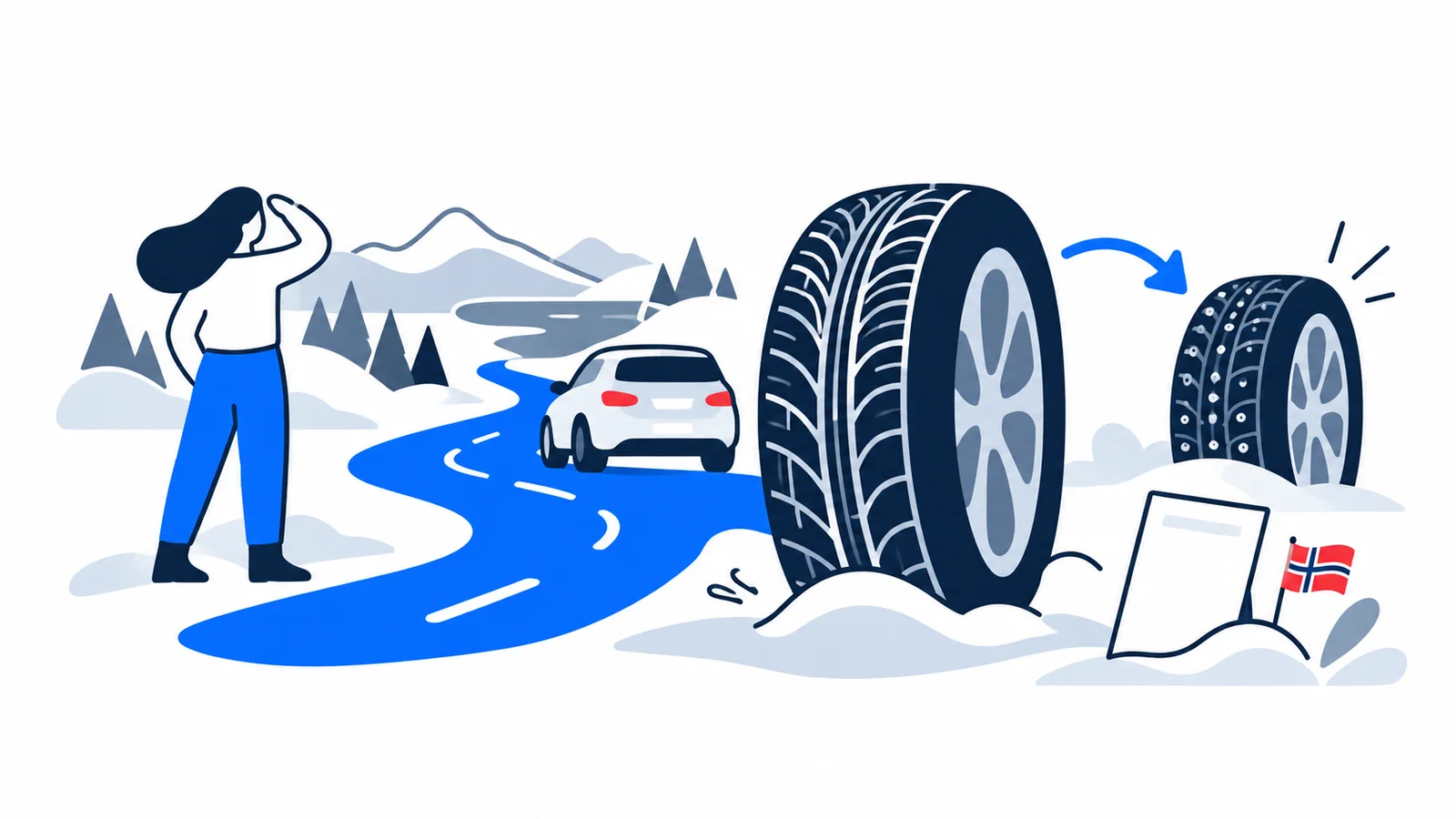
Spiked tyres are permitted from 1 November to the first Sunday after Easter Monday in most of Norway. In Nordland, Troms and Finnmark the season starts earlier, already on 16 October.
Outside these periods, spiked tyres are not permitted, unless road conditions are so difficult that it is necessary. Studless winter tyres, however, can be used all year, without any date restrictions.
| Area | Spiked tyres permitted |
|---|---|
| Rest of Norway | 1 November – first Sunday after Easter Monday |
| Nordland, Troms and Finnmark | 16 October – 30 April |
| Studless winter tyres | All year, no date restrictions |
The dates apply regardless of how much snow actually lies at that time. Even if the streets are bare on 1 November, it is still permitted to fit spiked tyres from that day.
What is a spiked tyre fee, and where must you pay?
Spiked tyre fees are charges for driving with spiked tyres in certain cities. Oslo, Bergen, Trondheim and Stavanger charge fees during the spiked tyre season, and one payment applies in all these cities.
You can usually choose between:
- Daily pass, for shorter stays in the city
- Monthly pass, if you drive there often
- Seasonal pass, if you live or work in the city throughout winter
The fee applies when you drive with spiked tyres in these cities, whether you live there or are just passing through. Payment is normally checked automatically, including via cameras at city boundaries, so it is worthwhile to arrange a pass before you drive in.
Prices change occasionally, so always check the current fee with the municipality before you drive in. If you drive without a valid pass, an additional fee will be added on top. Such extra costs come in addition to regular car ownership expenses, such as car insurance for newcomers.
What happens if you drive with illegal tyres?
The police and Statens vegvesen can issue you a fine if the tyres do not meet standards. The fine is issued per tyre, not per vehicle, so multiple poor tyres can become more expensive than you think.
The amount varies depending on how serious the breach is (check the current rate with Statens vegvesen or the police). If you do not pay within three weeks, the fine increases by fifty percent, even if you lodge a complaint.
This is not just about avoiding fines. Poor tyres result in longer braking distance and less control on ice and snow. The rule exists to protect you, your family and others on the road.
Statens vegvesen also carries out roadside inspections in several places in the country, particularly along main roads in winter. If an accident is traced back to poor tyres, it can also affect how the insurance company assesses your case afterwards.
Good advice before winter arrives
A little planning saves you stress and money when the cold arrives:
- Check the tread depth on all four tyres well in advance, preferably in September or October
- Book a tyre change appointment before the workshops become fully booked
- Buy a spiked tyre pass immediately if you live in Oslo, Bergen, Trondheim or Stavanger
- Consider studless winter tyres if you mostly drive in cities with maintained roads
- Keep a scraper, warning vest and possibly chains in your car
- Keep the receipt or screenshot of your purchased spiked tyre pass, in case you are inspected
- Allow extra time for your drive on the first snowy days
Winter tyres are just one part of being ready for a Norwegian winter. If you want to learn more about how to prepare for cold, power outages and slippery roads in general, you can read our guide about emergency preparedness in Norway. SamfunnPrep brings together this kind of practical knowledge in one place, so you don't have to search around on your own.
Winter tyres and civic knowledge in Norway
Understanding rules like this is part of feeling secure in everyday life in Norway. The same practical understanding of laws and rights appears again when you prepare for the civic knowledge exam.
Many newcomers are not familiar with all such practical rules from the start, and that is completely normal. Learning them gradually, through everyday life and through exam preparation, makes you more confident both as a driver and as a citizen.
At SamfunnPrep you will find questions and practice exams that cover exactly this type of topic, from traffic rules to rights and duties as a citizen. Do you want to test what you know? Try free and see how well prepared you are.