
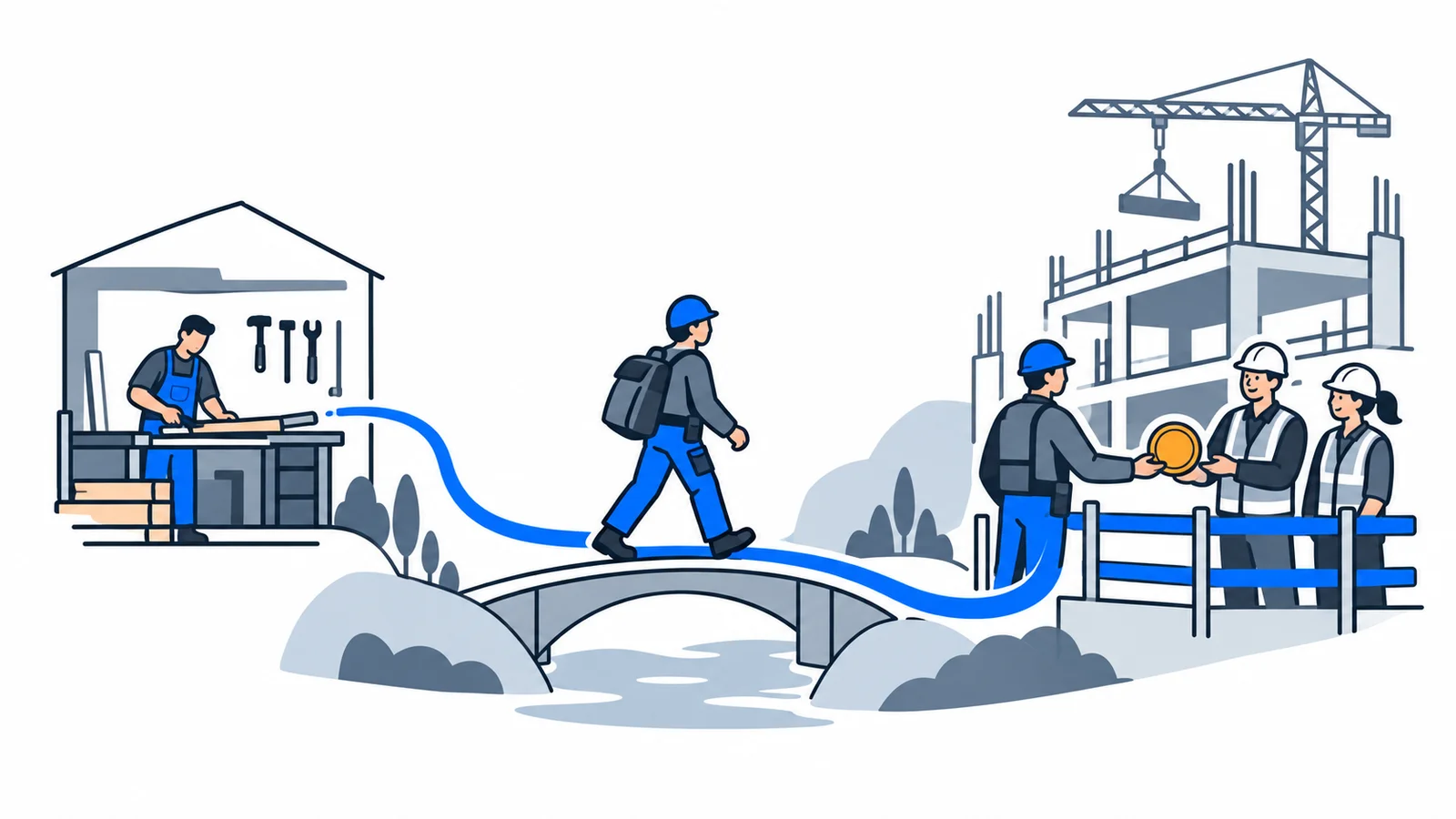

What does "posted worker" mean?
A posted worker is a person who works temporarily in Norway but is employed by an employer in another EU or EEA country. The employer sends you to Norway to perform a specific task, for example building, cleaning, transport or assembly, while your employment relationship remains with your home country. The scheme is different from ordinary labour immigration, because you don't change employer and the stay is time-limited. The rules follow from the EU posted workers directive and are incorporated into Norwegian law through the Working Environment Act and regulations on posted workers. The purpose is to ensure that you receive the same basic rights as Norwegian workers. As an EU/EEA citizen, you do not need a separate residence permit, but if the assignment lasts longer than three months, you must register with the police and obtain a registration certificate. Read more in our article about registration certificate for EEA citizens.
Wages and universal applicability
Even though you are employed abroad, you are entitled to Norwegian minimum standards while working in Norway. The most important is the universal applicability of collective agreements: in sectors such as construction and engineering, cleaning, road freight transport and agriculture, the authorities have set minimum wage rates that apply to everyone, regardless of which country the employer is registered in. This follows from the Universal Applicability of Collective Agreements Act, and the purpose is to prevent social dumping, that is, using foreign workers to push wages below what is normal in Norway. You also have the right to compensation for expenses for travel, meals and accommodation if the employer requires you to travel to Norway. The rules on working time in the Working Environment Act, including maximum working hours and rest periods, also apply to you. If the employer does not follow the universal applicability rates, you can contact the Labour Inspection Authority or a trade union. Please ask for a written employment contract before departure, so that wages and conditions are agreed in advance — see what a good contract should contain in employment contract in Norway.
Rights under the Working Environment Act
The Working Environment Act gives you rights that cannot be waived, regardless of what the contract says. This includes, for example, requirements for a sound working environment, protective equipment and protection against discrimination. You have the right to information about what wages and working conditions apply, and the employer must be able to document time sheets and wages. If the assignment lasts longer than twelve months, you receive even more rights under Norwegian labour law, with some exceptions. The Labour Inspection Authority is a contact point that can provide information about the rules, but cannot enforce payment of wages on your behalf. In cases of serious violations, such as very low wages, lack of protective equipment or inadequate accommodation, you should report it — the Labour Inspection Authority, the Tax Authority, the police and NAV work together against crime in working life, and you can submit a report anonymously.
OHS card and registration with the Tax Authority
If you work in the construction and engineering sector or cleaning, you must have a valid OHS card visible on you at the workplace. The card shows that you are legally registered. Without it, you can be removed from the construction site or workplace, and your employer can receive an order from the Labour Inspection Authority to rectify the situation. The card is valid for two years, but becomes invalid if the employment ends before that. To get the card, the employer must first report the assignment and you as an employee to the Tax Authority's Assignment and Employment Relationship Register, normally using form RF-1198 for employees and RF-1199 for the assignment itself. The reporting must take place no later than fourteen days after you start working, and applies to assignments over 20,000 kroner. Based on this, you are assigned a d-number and tax card. Although the employer has the main responsibility, you should check that the registration has actually been done, as deficiencies can create problems with tax and social security later.
A1 form and social security coverage
The A1 form confirms in which country you are a member of the social security system while you work in Norway. As a general rule, you remain covered by the social security system in your home country during a temporary posting, so you avoid paying social security contributions in both places. The form is normally applied for by your employer in your home country, and you should ask for a copy before departure. It is important if you become ill, are injured at work or need medical help in Norway, as it shows which country is responsible for your social security benefits. Without a valid A1, there may be uncertainty about who will cover sick pay or treatment. If you are unsure about social security coverage, you can contact NAV, which handles inquiries relating to posted workers from EEA countries.
Tax as a posted worker
Your tax liability depends on how long you stay in Norway. For a short stay, you are usually covered by the withholding tax scheme, where the employer deducts a fixed tax rate directly from your wages, and you do not need to submit an ordinary tax return. If you stay more than 183 days in a twelve-month period, or more than 270 days in three years, you normally become tax liable as a resident and must submit an ordinary tax return. Keep track of the number of days you spend in Norway. Regardless of the scheme, you should have the correct tax card, so that the employer deducts the correct tax from the first wage. You will find a general introduction in tax return in Norway, and if your income is low, the rules on exemption card may also be relevant.
Where can you complain?
If you experience that the employer is breaking the rules on wages, working hours or safety, there are several places to turn. The Labour Inspection Authority receives reports about violations of the Working Environment Act and the Universal Applicability of Collective Agreements Act, and you can report anonymously if you are concerned about retaliation. The Tax Authority can be contacted if you suspect missing registration or tax evasion. Trade unions often provide free advice to foreign workers, even without membership, and can help you recover unpaid wages. In serious cases, such as forced labour or human trafficking, you should contact the police directly.
Do you want to stay updated on the rules that apply to you as a posted worker? Register for free and get access to more guidance tailored to your situation in Norway.