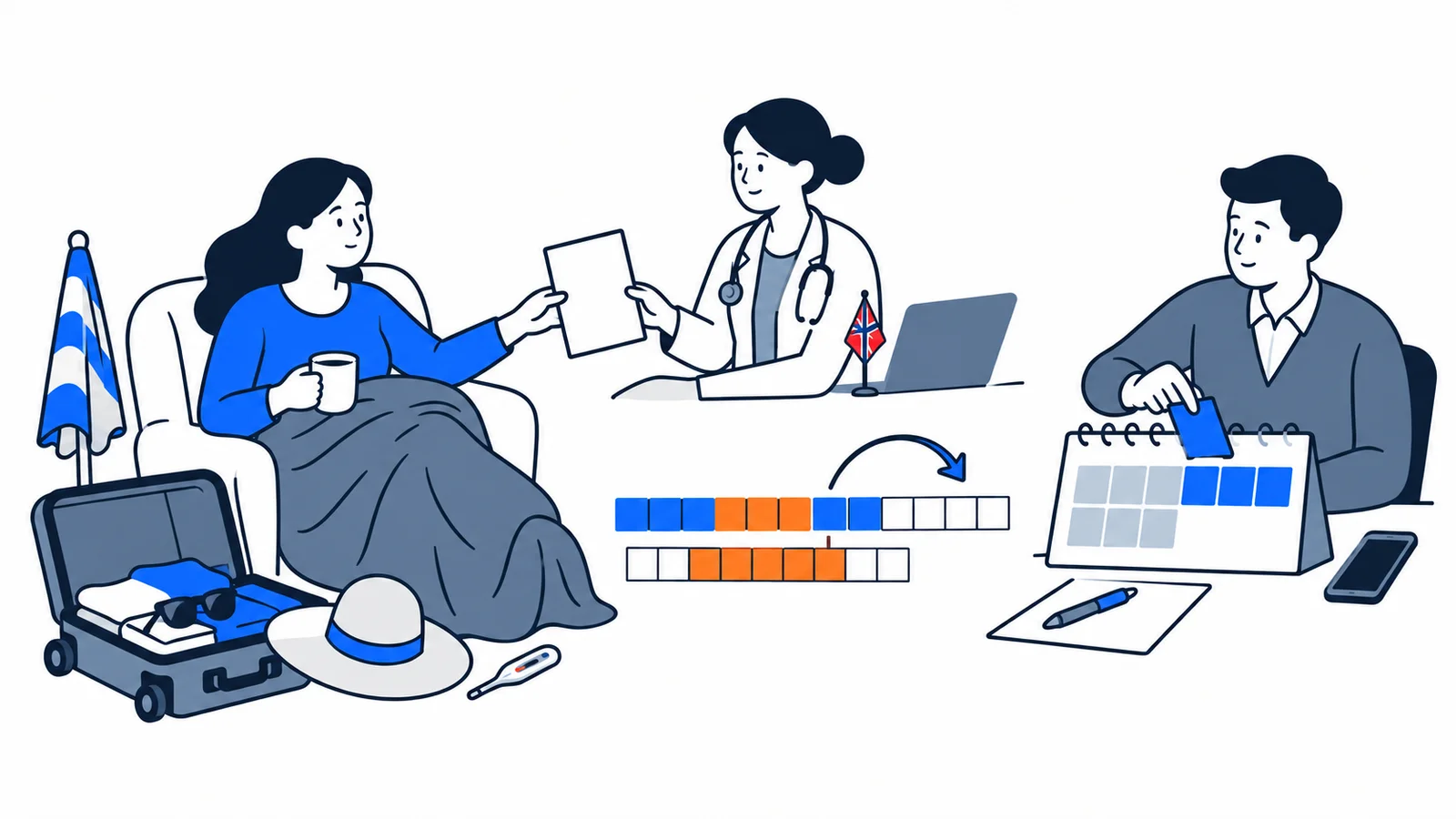

If you become completely unable to work just before or during your holiday, you can claim to have statutory holiday days postponed. This also applies if you become ill after your holiday has started, from the first day of illness. You need a doctor’s certificate, and the deadline for making the claim differs depending on whether the illness starts before or during your holiday.
Before your holiday or while it is under way?
| When the illness starts | What you can claim | When you must notify your employer |
|---|---|---|
| Before the holiday | That the holiday is postponed to later in the holiday year. | No later than the last working day before the holiday was due to start. |
| During the holiday | New holiday days for the days you were completely unable to work. | Without undue delay after you have returned to work. Contact the employer earlier if you can. |
In both cases, you must document 100% incapacity for work with a doctor’s certificate. Self-certification alone does not meet the documentation requirement in the Holiday Act. If you have a graded sick leave certificate, this rule does not give you the right to move the agreed holiday days. NAV also says that a partially sick-listed person who has agreed holiday must report the holiday in the sickness-benefit application.
The right applies to statutory holiday under the Holiday Act: normally four weeks and one day, plus an additional week for employees over 60. Many people have a fifth holiday week under an employment or collective agreement. Check what your agreement says about illness during the extra days. Do not assume that the same statutory rule automatically gives everyone the same right for additional days.
If you are ill but have only self-certified, contact a doctor promptly if you want to claim postponed holiday. Telling your employer that you are ill is important, but it is not the documentation required by the Holiday Act for new holiday days. If the illness begins only after your holiday has ended, it does not provide a basis for moving holiday you already took before becoming ill.
Follow these steps in order
- Contact a doctor when you become ill. Explain your work situation and that you are on holiday or about to start it. The doctor assesses whether you are unable to work and to what extent.
- Notify your employer about the illness and that you want to claim postponed holiday. Use a written channel you can refer back to. Before the holiday, your claim must arrive no later than the last working day before it starts.
- Send the doctor’s certificate or sick note as your employer requests, using a secure channel. Document the dates on which you are completely unable to work.
- Confirm the postponed holiday days in writing with your employer. Agree later on when the replacement days will be taken. Do not change the calendar entry unless both parties agree.
- Complete the NAV application correctly if you are claiming sickness benefits. NAV explains that you should answer “no” to the question about holiday if the holiday was actually postponed, and “yes” if you took it as agreed.
If you became ill during your holiday, the claim under the law must be submitted without undue delay after you return to work. You do not have to wait to notify your employer if you can contact them earlier. This helps with planning, but does not replace the doctor’s certificate.
A short message could read:
Hello. I am certified 100% sick from [date] to [date] and claim that the statutory holiday days falling in this period be postponed under section 9 of the Holiday Act. I will send the doctor’s certificate through [agreed secure channel]. Please confirm which days you are recording as postponed holiday. Regards, [name].
Example: illness in the middle of planned holiday
Leila has holiday from Monday 6 July to Friday 17 July. She is completely unable to work from Thursday 9 July to Wednesday 15 July and receives a doctor’s certificate. She notifies her employer and claims postponed holiday for the holiday days that overlap with the period of illness. She asks for a written summary of the number of days to be taken later. She cannot automatically demand that her trip be extended or choose new dates without agreeing on the timing.
Write the dates in two columns: planned holiday and documented 100% illness. Only the overlap is relevant to this claim. If the sick note lasts longer than the holiday, days after the holiday are treated as ordinary sick leave. If you were already off for another reason, such as time off in lieu, those may not be holiday days that can be moved under the Holiday Act.
Arbeidstilsynet notes that Saturday can count as a working day for holiday purposes, even if you do not usually work that day. So “three working days” and “three holiday days” may mean different things. Ask your employer to show the calculation if you are unsure. See also holiday and holiday pay for the difference between time off and payment.
Holiday days and sickness benefits are separate questions
The fact that holiday days can be postponed does not mean that NAV automatically pays sickness benefits for the entire period. NAV assesses the sickness-benefit conditions, and the employer period may depend on whether the holiday was actually postponed. If you take holiday while on sick leave, sickness benefits stop during the holiday. If illness leads to the holiday being postponed, report this correctly in your sickness-benefit application. The sickness-benefit guide explains the basic rules.
Illness during a trip abroad can raise additional questions: medical documentation, sickness benefits during a stay abroad, and what travel insurance covers. Contact your employer and NAV well in advance if you are unsure. In particular, outside the EEA, do not assume that a foreign sick note automatically qualifies you for Norwegian sickness benefits. Travel insurance is a separate agreement and does not replace the Holiday Act.
If the employer rejects your claim, ask for written reasons. Compare the dates, sick-leave percentage, and documentation with the conditions above. Contact your employee representative, trade union, or Arbeidstilsynet for general guidance. SamfunnPrep has more explanations about working hours and holiday; a specific disagreement about your days must be resolved with your employer or an appropriate adviser.
Sources checked 2 October 2026: Arbeidstilsynet on holiday and illness, section 9 of the Holiday Act, and NAV on holiday in sickness-benefit applications.