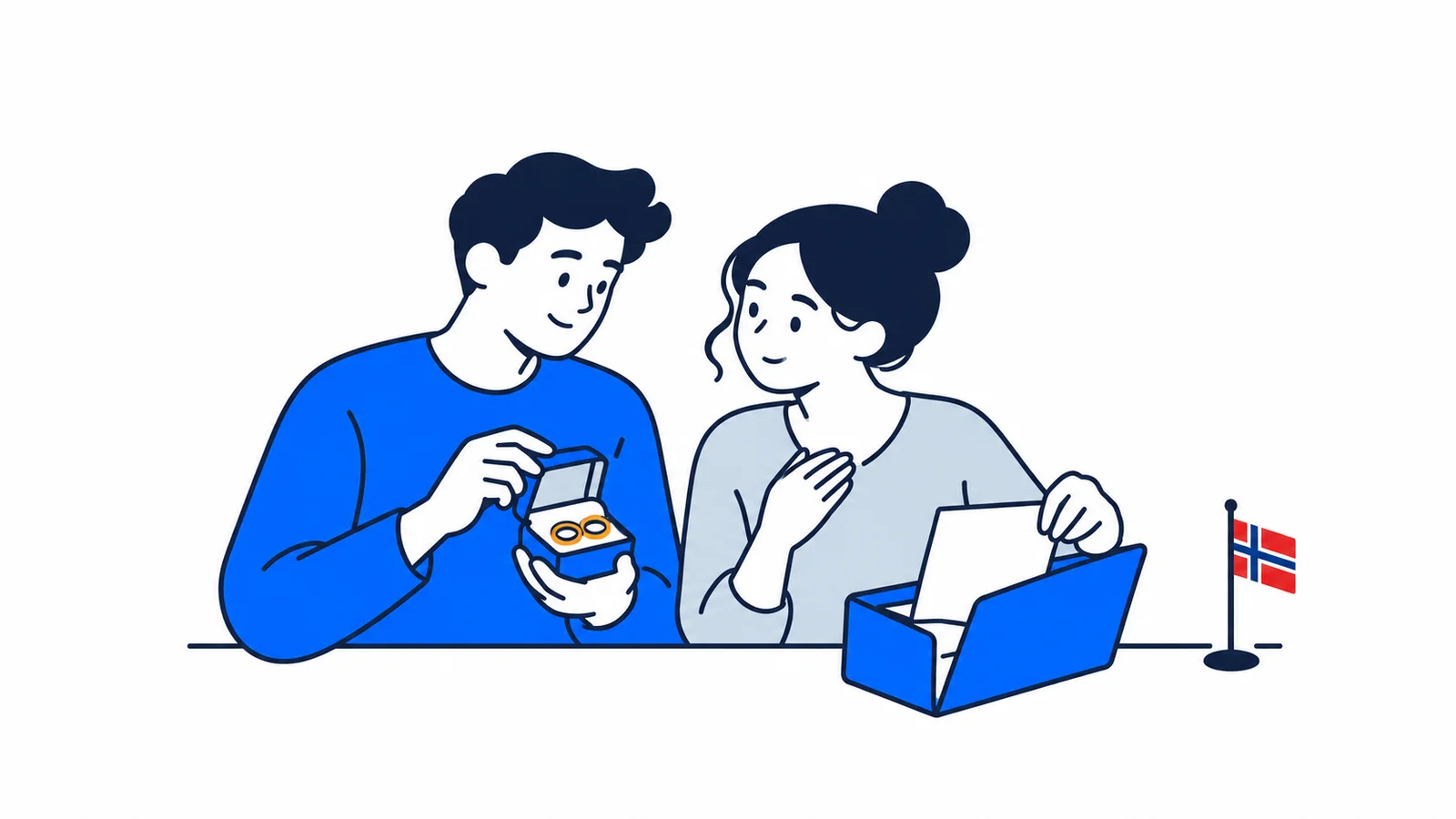

A residence card for the family of an EEA national may be the right route if you are from a country outside the EEA. You must document both your family relationship and the EEA national's residence rights. Applying alone does not give you the right to work.
Who is this 2027 plan for?
The plan is mainly for you if you are moving to join your spouse in Norway and are not an EEA national yourself. EEA means the European Economic Area. The rules were checked on 20 October 2026 for planning in 2027. Check them again before applying.
There are three different routes. If you are an EEA national yourself, you normally use the registration scheme. If you are from another country, EEA family rules may cover you. Other families apply under ordinary family immigration rules.
Start with UDI's residence card guide. UDI is Utlendingsdirektoratet, the Norwegian Directorate of Immigration, which handles immigration cases. SamfunnPrep also has tools to organise your first steps.
Is a residence card the same as a family permit?
No. A residence card under EEA rules documents residence rights based on your family member. Ordinary family immigration is a different scheme with different conditions.
The sponsor is your family member in Norway. The applicant is you, the person moving here or continuing to live here. Both people's circumstances determine which route you use.
| Your situation | Scheme to investigate |
|---|---|
| You are an EEA national yourself | Registration scheme for EEA nationals. |
| You are not an EEA national and are joining an EEA spouse in Norway | Residence card as a family member. |
| You are joining a Norwegian spouse who has always lived in Norway | Ordinary family immigration is normally the starting point. |
| You and your Norwegian spouse lived together in another EEA country | Check the special EEA rules for returning to Norway. |
The last row does not mean that a holiday in Sweden creates a new application route. You must check the specific conditions concerning previous residence and family life. This guide mainly concerns the family of another EEA national in Norway.
What must you document?
You must document a family relationship covered by the scheme and a valid residence basis for the sponsor. A registration certificate alone does not show that the basis still exists.
For spouses, the marriage must be valid. You must plan to live together in Norway. The relationship must be voluntary and genuine. UDI has separate categories for, among others, cohabitants, children and parents. Do not use the spouse checklist if you belong to another category.
For example, the sponsor may work, run a business, study or live here with sufficient own funds. Financial support and health insurance may matter, especially for students or people with own funds. The requirements are not identical in every category.
Make two document folders: one for the family relationship and one for the residence basis. The first might contain passports and a marriage certificate. The second might contain an employment contract, payslips or documents for the sponsor's other basis. Always follow UDI's personalised checklist.
How do you apply for the card?
You must apply for a residence card if you will live in Norway for more than three months as a family member from outside the EEA. Register the correct case with UDI and follow the instructions about appointments and submitting documents.
A practical order is:
- Enter the correct citizenship for both people in UDI's guide.
- Choose the family category that actually fits.
- Read the conditions for both applicant and sponsor.
- Register the application and book an appointment as instructed.
- Collect the originals and necessary translations on the checklist.
- Keep the receipt and copies of the documents you submit.
Check entry requirements before buying a ticket too. Being able to apply for a residence card does not mean you can travel without a passport or a required visa. Check visa requirements and possible exceptions for your circumstances.
If the EEA national is registering at the same time, use the registration certificate guide. Remember that your card application and the other person's registration are different tasks.
Can you work while waiting for your residence card?
Yes, if you already meet all the conditions for residence rights as a family member. You must be able to document this yourself. Submitting an application is not enough.
UDI makes an important distinction when the sponsor will be an employee. If the employment contract starts in a few weeks, you cannot work before the EEA national has actually started the job. A future employment contract is not the same as having started work. See UDI's questions about EEA residence.
Example: Your Swedish spouse is due to start work on 1 March 2027. You arrive on 10 February. You cannot use the future job alone as the basis for you to work from 10 February. Establish whether another actual basis exists, or wait until the conditions are met.
Ask your employer to check the evidence before you start work. If you need a tax deduction card before the residence card is ready, contact Skatteetaten, which handles tax and population registration. A tax deduction card does not itself give residence rights or the right to work.
Can you travel while the application is being processed?
UDI recommends waiting until you have a valid residence card before travelling abroad. An application receipt is not a reliable substitute at the border or with the airline.
This matters particularly if an earlier visa or residence card expires during the trip. Check documents for the return journey and any connections. Ask UDI for guidance before booking if the situation is unclear.
What should you keep for permanent residence rights?
Permanent residence rights may become relevant after five years of continuous lawful residence. This is a separate EEA scheme, and its conditions must be checked separately.
Keep documents for every year, including when the sponsor changes jobs or residence basis. A folder containing only the first registration certificate cannot show the whole residence history. Record foreign travel and important family changes too.
Read the rules on permanent residence rights as you plan ahead. Do not use the usual calculation for a permanent residence permit as if the schemes were the same.
Ready to practise? Try SamfunnPrep for free.