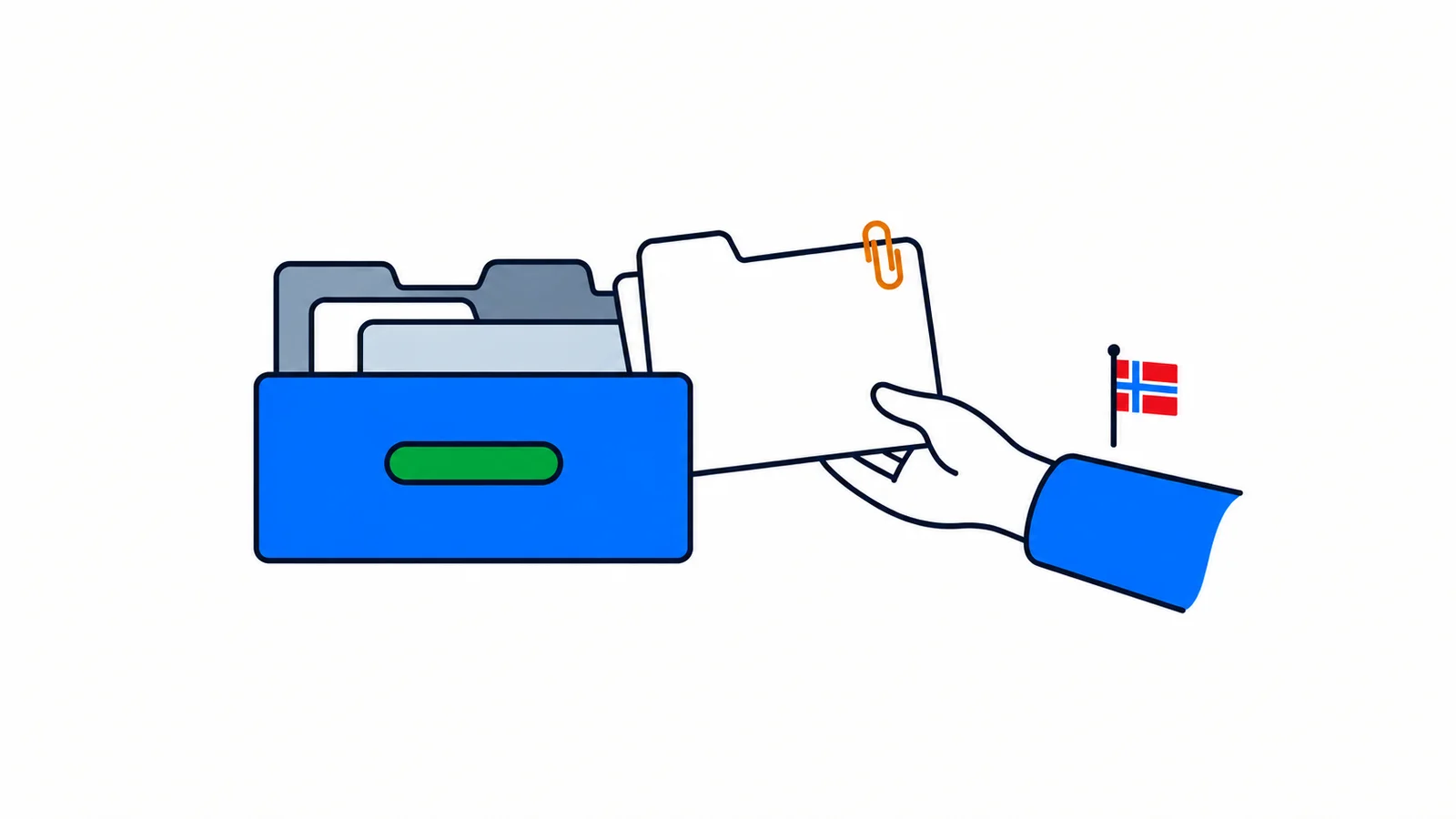
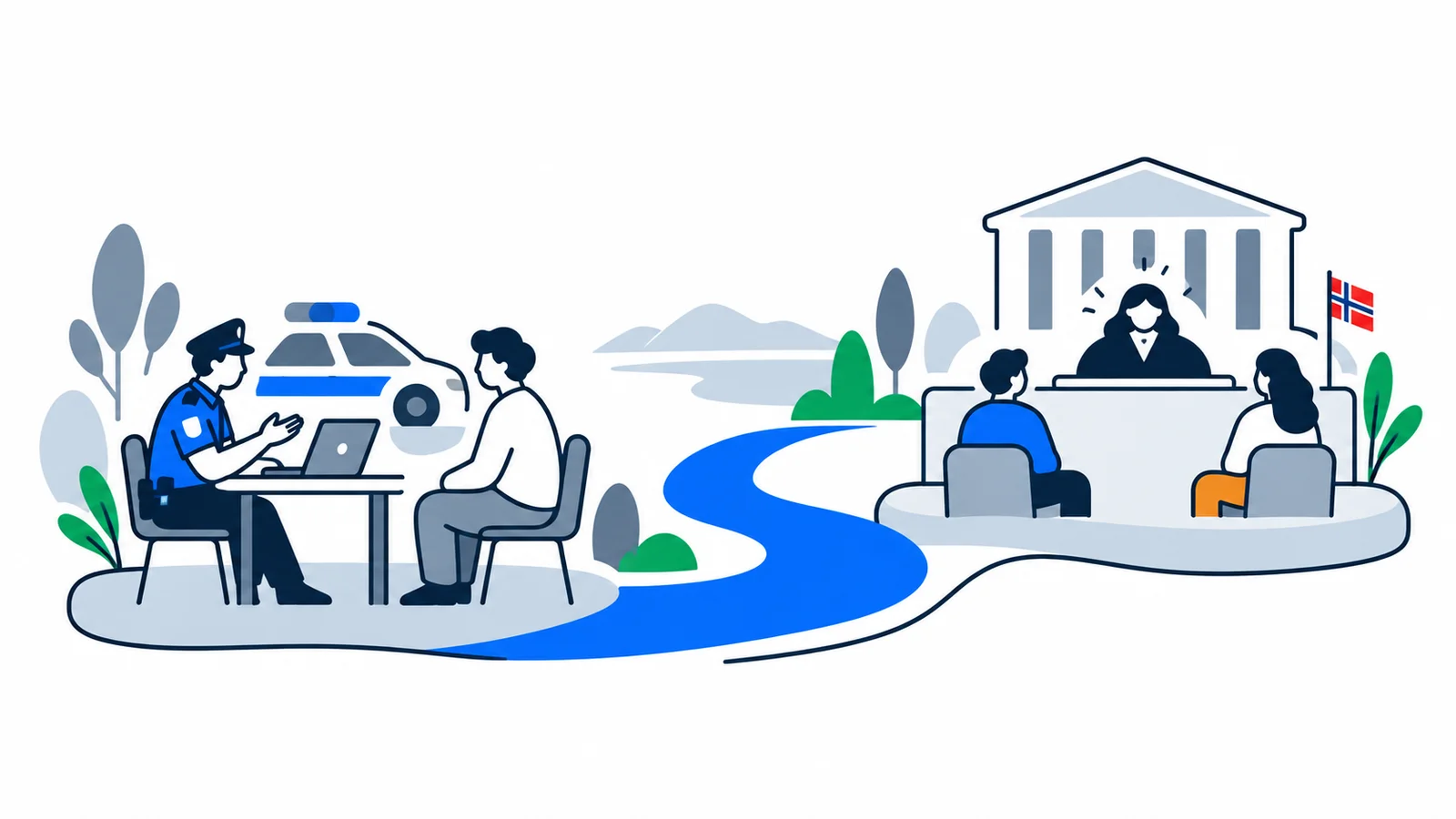

Crime and punishment in Norway follow clear rules: the police investigate, courts convict, and punishment should both protect society and help people return to a law-abiding life.
What do crime and punishment mean in Norway?
Crime and punishment in Norway are based on the law applying equally to all. A crime is an action that the Penal Code prohibits. Punishment is the reaction society gives when someone breaks the law.
Norway is a rule of law state. This means that power is divided, and no one can be punished without a fair process. You can read more about courts and the rule of law in a separate article.
The rules are in the Penal Code from 2005. All Norwegian laws are free to read on Lovdata online. No one can be punished for something that was not forbidden when the action took place.
Most people living in Norway never encounter a criminal case. But it is useful to know how the system works and what rights you have.
Three institutions collaborate in a criminal case. The police investigate, the prosecution decides whether to press charges, and the courts convict. Kriminalomsorgen is responsible for implementing the sentence.
From report to conviction: how a criminal case proceeds
A criminal case usually starts with a report to the police. You can report it yourself if you have experienced something. See how in the guide how to report to the police.
The police investigate the case and gather evidence. In large or complex cases, Kripos (the national investigative unit) helps. During the investigation, the suspect has rights throughout.
Then the prosecution evaluates the evidence. They can dismiss the case, issue a summons (a fine), or press charges in court. Most cases end with a summons and never go to trial.
Some minor cases can be sent to a mediation board. There the parties meet and try to reach agreement instead of regular punishment. This is often used for young offenders.
If the case goes to court, the defendant receives a trial. A judge, and often lay judges, determine guilt and punishment. Lay judges are ordinary people, not lawyers. The court is usually open so that everyone can see that the process is fair.
The three courts: district court, appeals court, and Supreme Court
Norway has three levels of ordinary courts. Almost all criminal cases start in the district court. Then the conviction can be appealed.
| Court | Role | Scope (as of July 8, 2026) |
|---|---|---|
| District Court | First instance, judges most cases | 28 district courts, 59 court locations |
| Appeals Court | Handles appeals from the district court | 6 appeals courts |
| Supreme Court | Highest court, decides on matters of principle | 20 judges |
Both the convicted and the prosecution can appeal a sentence. Appeal means that a higher court reviews the case again. The Supreme Court takes only the most important cases.
What penalties exist in Norway?
Norway has several types of penalties, not just imprisonment. The court chooses punishment based on how serious the crime is.
- Fine / summons — a monetary amount; the most common penalty.
- Suspended sentence — you avoid serving time if you stay away from new crimes, often for two years.
- Unconditional imprisonment — you serve time in prison. For ordinary crimes, the sentence is between 14 days and 21 years.
- Community service — unpaid work, between 30 and 420 hours, instead of imprisonment.
- Preventive detention — for the most dangerous crimes; the time limit is a maximum of 21 years, but can be extended by five years at a time.
Imprisonment for 21 years is thus the normal upper limit. Norway has neither capital punishment nor life imprisonment. For young people under 18, there are separate penalties, such as youth sentences.
What rights do you have if you are suspected?
You have strong rights if the police suspect you. These apply to everyone, regardless of background or citizenship.
- Presumption of innocence — you are considered innocent until proven otherwise.
- Right to defense — you have the right to a lawyer who represents you.
- Right to silence — you do not need to explain yourself against yourself.
- Equality before the law — the same rules apply to everyone.
- Right to interpreter — if you speak little Norwegian, you have the right to a free interpreter at questioning and in court.
In serious cases, the state pays for the defense lawyer. This way, everyone gets a real defense, even those who cannot afford it themselves. You also have the right to see the evidence in your case.
This is called legal security. The rules are meant to prevent innocent people from being punished. They are closely related to human rights in Norway.
The police and courts are independent and free to use. No politician can determine the outcome of an individual case.
Why does Norway emphasize rehabilitation?
Norwegian punishment aims to help people return to a law-abiding life. The idea is that most inmates will eventually be released. It is then safest for society if they do not commit new crimes.
Kriminalomsorgen therefore offers education, work, and health care during imprisonment. The vision is "punishment that changes." Many serve in open prisons with more freedom toward the end, and some serve at home with electronic monitoring.
An important principle is that life in prison should resemble life outside as much as possible. The punishment itself is the loss of freedom, not poor conditions. The goal is for the prisoner to manage on their own afterward.
This model seems to work. Recidivism to new crime was around 20 percent in 2015 and fell to about 15 percent in 2017 (source: Kriminalomsorgen). It is low compared to many other countries.
Rule of law, clear penalties, and rehabilitation are topics you may encounter on the civic knowledge test. With SamfunnPrep you practice exactly these kinds of questions. The courses in SamfunnPrep explain how the police, courts, and Kriminalomsorgen work together.
Ready to practice? Try SamfunnPrep free.