
A cold rented home may have a defect if the heating or the property does not match the agreement. Document the problem and notify your landlord in writing. Ask for repairs before considering a rent reduction or withholding money.
What should you do first if your rented home is cold?
Identify what is failing and notify your landlord promptly. A heater that does not work should be described differently from high electricity prices.
Look for a simple explanation. Check the heating settings and whether windows are open. Use the equipment as the instructions say. Ask your landlord to explain the system if you are unfamiliar with it.
Then find your agreement. Does it say the home has underfloor heating, a heat pump or another heat source? Does it say who pays for electricity and maintenance? SamfunnPrep has a guide to the tenancy agreement explaining these parts.
If you speak to your landlord by phone, send a short written summary afterwards. This gives both of you the same description of the fault and the next step.
The guidance below is based on sources checked on 4 October 2026. It concerns renting a home in Norway.
Is cold a defect in the property?
Cold may be a defect, but the assessment depends on the agreement, the property's condition and the cause. One temperature measurement alone does not determine who is responsible.
Husleietvistutvalget, the public body that handles tenancy disputes, explains that a defect means a departure from the agreement. Unless otherwise agreed, the home must be in a normal good condition. See Husleietvistutvalget's explanation of defects and claims.
These situations need different investigations:
| Situation | What you should document | First question for the landlord |
|---|---|---|
| Agreed underfloor heating or a radiator does not work | Which rooms and functions are affected | When can the system be checked? |
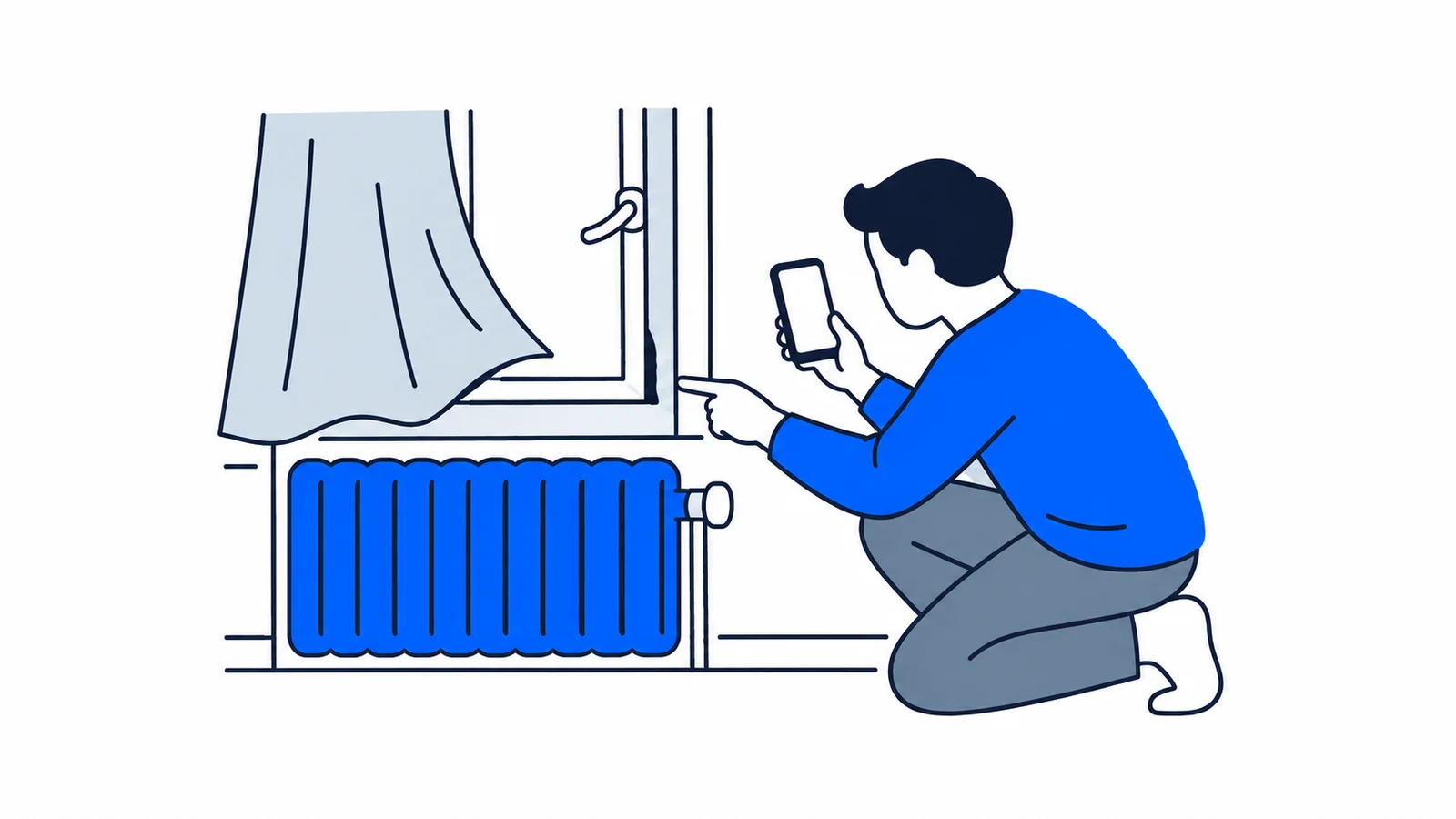
| A strong draught around a window or door | Where the draught comes from and any visible faults | Can sealing or another repair be considered? |
| Heating works, but you cannot afford to use it | The bill and the electricity payment agreement | Is there an error in the basis for the payment? |
The table is a practical way to sort the problem, not a decision on compensation. A home's age alone does not determine whether you have a claim either.
Do not use a temperature limit from an online forum as proof that your landlord is automatically breaking the law. Describe the conditions and connect the problem to what you agreed.
How to document heating failure and draughts
A short log shows how the problem develops over time. Combine measurements with information about heating and how the room is used.
Consider recording:
- The date, time and room where you measured.
- The temperature and where the thermometer was placed.
- Which heating was on and its setting.
- Whether windows were closed and whether you had recently aired the room.
- Where you feel a draught or which equipment does not work.
- When you notified your landlord and what response you received.
Use the same position for later measurements. A measurement right beside a heater or an open window may give an unclear picture. Photograph visible faults and the settings if relevant.
Example: The living room's underfloor heating is switched on, but the floor does not get warm. Record when you noticed this and what you have already checked. Ask for the underfloor heating to be investigated. Do not write that the whole building has poor insulation if you do not know this.
Also keep the advert, tenancy agreement and any move-in report. They may show which heating the home was meant to have.
Who should repair the heating?
Responsibility for maintenance may be set out in the tenancy agreement. Without a separate agreement, the landlord has the main responsibility, but the law also gives the tenant some tasks.
Husleietvistutvalget distinguishes between maintenance, replacement and damage caused by incorrect use. The tenant is normally responsible for certain smaller items and equipment that are not part of the property itself. Replacing the landlord's items follows a separate rule. See the guidance on maintenance responsibility.
Ask for clarification about the specific item that is broken. Avoid ordering a major repair in your landlord's name before responsibility and payment have been clarified.
You do not automatically have a right to your landlord buying additional portable heaters either. Ung.no explains this in an answer about an icy rented home. A specific fault in the agreed heating must be assessed separately.
When necessary maintenance is carried out, you must allow access to the home. Agree on a time. Your landlord should normally give advance notice, as the rules on access to the home describe.
How to write to your landlord
Write what is wrong, when it started and that you are asking for repairs. This notice is called a reklamasjon, a complaint about a fault.
Husleietvistutvalget says you must complain within a reasonable time. Do not wait until winter is over. The guidance on complaints about faults recommends written notice and proof that it has been sent.
You can adapt this text:
I am notifying you that the heating in [room] does not work as agreed. I discovered the problem on [date]. I have checked [settings]. A log and photographs are attached. I ask for the fault to be investigated and repaired. When can this be done? Please also let me know about a temporary solution.
Send the message through a channel you use for the tenancy. Keep the reply. If your landlord promises repairs, ask for the date and who will come.
Can you ask for lower rent or withhold money?
In some cases you can claim a rent reduction or compensation when a defect is not repaired. Your landlord must first have an opportunity to fix it within a reasonable time.
A rent reduction means lower rent because the home's rental value has been reduced. Withholding means retaining money to secure a claim. These are different actions. Neither gives a fixed percentage simply because the home is cold.
When withholding rent, the amount must be proportionate to the defect and the claim. You must notify your landlord of the reason and how much you are withholding. Get advice on your situation before using this measure. Husleietvistutvalget also describes depositing disputed rent in a special account.
Keep receipts for necessary extra expenses. A receipt proves the expense, but does not alone determine whether your landlord must pay it.
If your landlord does not reply
Follow up in writing with the first message and the documentation. Ask for a specific response about investigation and repairs.
If you still disagree, the case may be suitable for Husleietvistutvalget. SamfunnPrep explains how to complain in a tenancy dispute.
Create one folder containing the agreement, log, messages and receipts. SamfunnPrep's tools page also offers help with organising other practical tasks in Norway.