
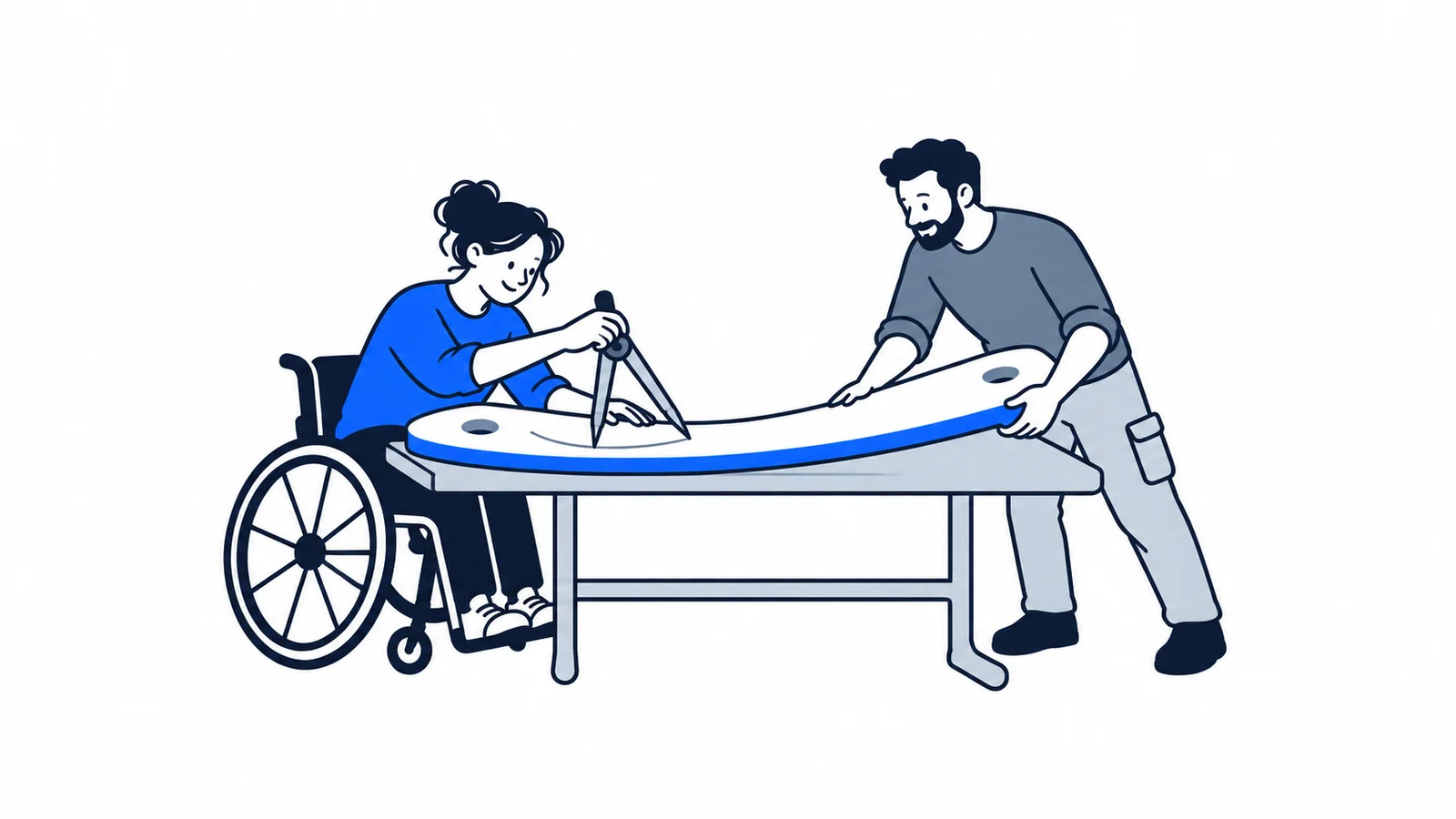

Workplace assistance (funksjonsassistanse) is practical help at work for people with extensive physical disabilities or severely impaired vision. Your employer applies to Nav together with you. The assistant helps you do your job but must not take over your usual work tasks.
Who can receive workplace assistance from Nav?
You must be in ordinary paid employment and need the assistance to be able to work. Nav, the Norwegian Labour and Welfare Administration, assesses your needs. A diagnosis alone does not automatically entitle you to a particular number of hours.
Section 6-3 of the Regulations on Labour Market Measures limits the scheme to people with extensive physical disabilities, blind people and people with severe visual impairment. The rules were checked on 2 November 2026. Nav's information for employees explains how the scheme works. Apprentices with an apprenticeship contract and apprentice pay may also be covered for the duration of the contract. Work supported by a wage subsidy can be combined with the scheme.
Other workplace adjustments and relevant assistive devices must be clarified before the need for assistance is assessed. It can therefore help to start with what already works and which practical barriers remain.
The scheme does not provide a general right to an extra colleague. Its purpose is to enable you to use your own skills at work. You can find more explanations in SamfunnPrep's article directory.
What should the assistant do?
The assistant provides necessary practical help while you perform your usual work tasks yourself. The help can relate both to your work and to personal needs in the work situation.
Nav's guidance for workplace assistants makes the boundary clear: the assistant must not take over your job when you are ill or otherwise absent either. This is support for you, not a substitute worker for your position.
When describing your needs, distinguish your professional work from what makes that work possible. An illustrative example is an employee who plans and conducts a meeting themselves but needs practical help along the way. Describe exactly what the help consists of. Nav must assess whether it fits the scheme.
The assistant can be a colleague who is given time for the role, someone your employer hires or someone supplied externally. Nav does not set a specific educational requirement for the assistant, but the person must be able to provide the practical help needed.
Also agree on how you will communicate with each other. Cooperation is easier when you know which tasks the assistant will do and which decisions and tasks you retain yourself.
Who applies, and who receives the money?
Your employer applies for workplace assistance in cooperation with you and signs the application. This guide is for employees. Self-employed people and freelancers should clarify the procedure with Nav; the regulations also allow direct payment to them.
Nav's guidance for employers recommends contacting the local assistive technology centre before the first application. Nav hjelpemiddelsentral advises on assistive devices and workplace adjustments. You can also contact the centre or a Nav office for information.
A practical sequence is:
- Ask your employer for a meeting about your needs.
- Describe what you do yourself and where you need practical help.
- Review the adjustments and assistive devices that have been considered.
- Contact Nav hjelpemiddelsentral to clarify the next steps.
- Have your employer use the application route on Nav's updated page.
- Read the decision and clarify the arrangements before making a fixed plan.
Nav reimburses wage costs to the assistant's employer. That employer also submits reimbursement claims. If the assistant comes from an external provider, this may be a different business from your own employer.
Ask who will follow up the application, the decision and the hours. Do not assume all expenses will be covered just because an application has been submitted.
What should you prepare before the meeting?
Write a short description of a typical working day and the situations where practical help is necessary. This is preparation advice, not a complete list of mandatory attachments.
You can use this overview:
| Topic | Example of what you can note down |
|---|---|
| Your tasks | Which tasks are you responsible for performing yourself? |
| Practical barriers | When do you need help to continue your work? |
| Time | How often does the need arise, and roughly how long does it last? |
| Measures tried | What has been changed, and which assistive devices have been considered? |
| Work locations | Do you work in one place, at home or at different meeting venues? |
| Contacts | Who can explain the work situation and follow up agreements? |
Use specific situations rather than just “I need a lot of help”. For example, describe the difference between a normal office day and a day with meetings. Do not exaggerate or hide variations to make the overview look simpler.
Nav's page on workplace adjustments explains that the occupational health service can help assess adjustment needs. You and your employer can contact the assistive technology centre if you need more guidance. Ordinary equipment that a business needs for its normal operations is not covered as an assistive device by Nav.
Ask which documentation is needed in your particular case. Ask for an explanation if a question or form is difficult to understand.
How many hours can you receive, and is this the same as BPA?
Hours are assessed individually and cannot exceed the hours you actually spend in ordinary paid work. The decision is linked to a particular employer. Each year, Nav assesses with you and your employer whether the arrangement is working.
The scheme has a limited budget. This means it operates within an allocated financial framework. Nav describes continued assistance as dependent on that budget not being reduced and on the need and eligibility conditions still being met. Do not interpret a decision as an unconditional guarantee for the indefinite future.
User-controlled personal assistance (BPA) is the municipality's responsibility, while workplace assistance is a scheme provided through Nav hjelpemiddelsentral. The same person can be an assistant in both schemes, but the roles must be kept separate. Read SamfunnPrep's explanation of BPA and applying to the municipality.
Blind and visually impaired people may also qualify for reading and secretarial assistance. Nav says reading and writing tasks should be handled through that scheme, even if the same person is also the workplace assistant. Clarify the division before planning the hours.
What should you do if things change or your application is refused?
Contact the assistive technology centre when your needs change, during a long absence or when your employment ends. As the decision is linked to the employer, you must clarify the arrangement when changing jobs.
Workplace assistance is used when you are actually at work. If the assistant becomes ill, your needs must still be met. Agree with your employer whom to contact when the help is unavailable.
Assistance on work trips normally requires approval before the trip. For predictable, regular travel, Nav can instead approve a fixed amount for a period. Clarify this before booking the trip.
If you have received a refusal, you can appeal to Nav hjelpemiddelsentral. Read the decision for the recipient, procedure and deadline. An application must have been processed; an oral answer is not a decision you can appeal. Explain what you believe is wrong and what information you want Nav to consider.
SamfunnPrep's practical tools help you find your way around Norwegian services. For assessment of your needs and the next steps in the application, your employer and Nav hjelpemiddelsentral are the right contacts.