
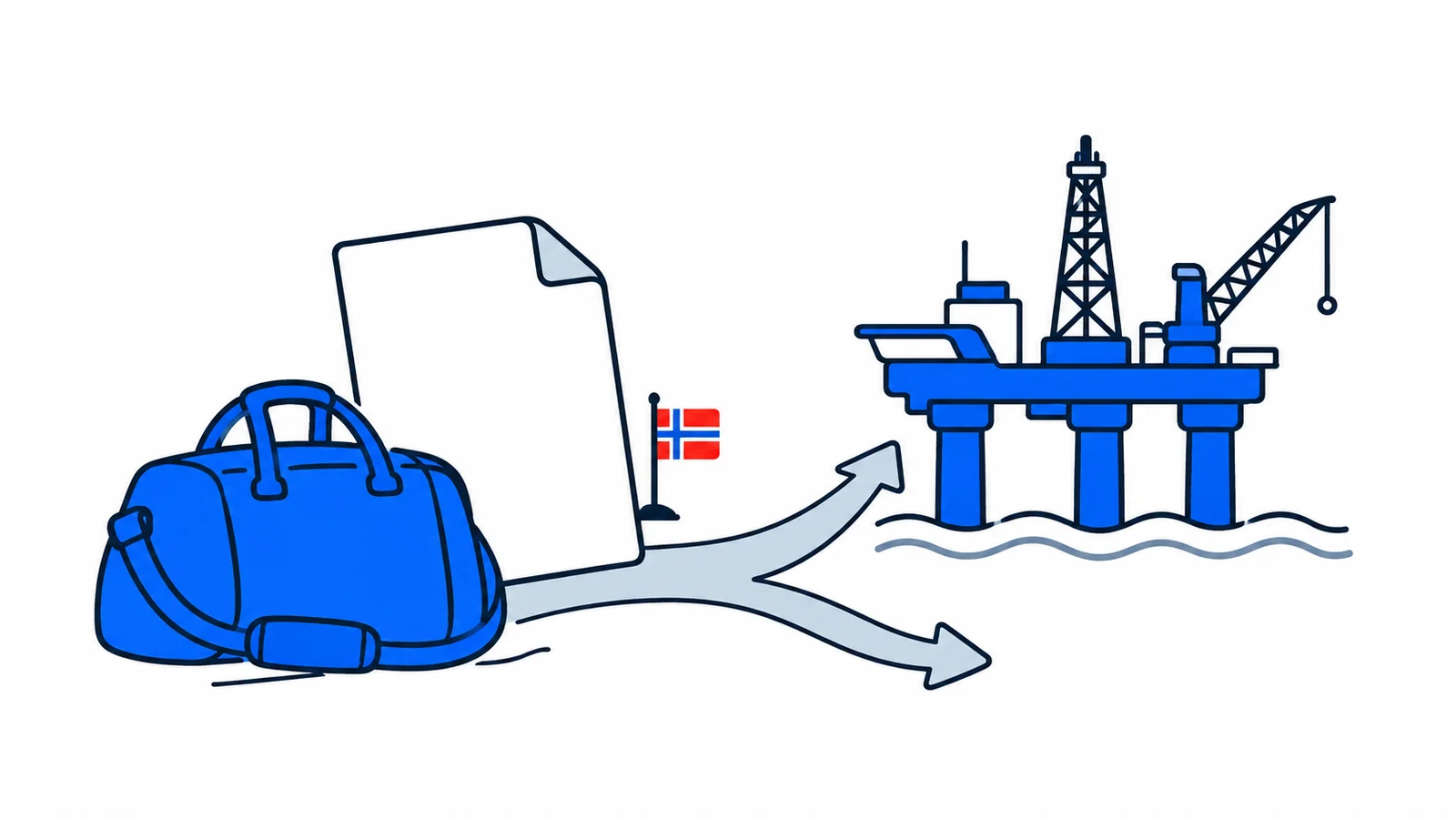

Offshore work does not automatically exempt you from a residence permit. A specific exemption covers certain mobile installations on the Norwegian continental shelf. Clarify the employer, installation and travel plan before choosing your residence route.
Who needs to clarify residence before offshore work?
You should clarify the residence rules when you get work on the Norwegian continental shelf and do not already have a residence right covering that work. The word “offshore” in a job advert is not enough to decide the matter.
Utlendingsdirektoratet (UDI) is the authority processing residence applications. This guide uses UDI information checked on 4 October 2026. It is particularly intended for workers from countries outside the EU/EEA, the European Union and European Economic Area.
If you already have a permit, read the conditions in the decision. If your citizenship or status follows other rules, use the guidance for that status. You should not apply under a new category simply because the work takes place at sea.
For ordinary Norwegian employment, residence as a skilled worker may be relevant. This guide explains the difference between a narrow offshore exemption and work requiring the appropriate permit.
Which offshore work can be exempt?
As of 4 October 2026, UDI describes an exemption for work on a Norwegian or foreign mobile installation on the Norwegian continental shelf. The installation cannot be in a fixed production phase or connected to a fixed platform.
All parts of this description must be assessed. The fact that an installation can be moved is not enough by itself if it is currently used for fixed production. The actual situation must be documented.
Ask the employer to identify the installation and explain how it operates. You need a specific answer about the installation, rather than simply confirmation that the company works in oil or maritime activities.
Use UDI's offshore guidance under skilled workers and select your own citizenship in the guide. If the description does not clearly fit, the employer and authorities must clarify which residence route applies.
What distinguishes the different situations?
Distinguish between work on a qualifying mobile installation, other work at sea and tasks on land. Having the same rotation schedule or job title does not make these situations equivalent.
| Work situation | What needs clarification? | What should you avoid assuming? |
|---|---|---|
| Mobile installation on the Norwegian shelf | Operating phase, connection and notification duties | That “mobile” alone gives an exemption |
| Fixed platform or fixed production | Correct residence permit or another residence right | That all offshore work is exempt |
| Workshop, base or office on land | Residence basis for work on land | That the offshore exemption covers extra land work |
| Foreign employer on a Norwegian project | Employment and project contract | That a Norwegian workplace means a Norwegian employer |
The table helps you ask questions. It does not decide your case. Request clarification if you alternate between several workplaces.
An illustrative example: you will maintain equipment both on an installation and in a workshop in Norway. Even if the work at sea is covered by an exemption, the right to work in the workshop must be clarified separately.
Who must notify the police, and when?
Under the offshore exemption, both employer and worker have a duty to notify. As of 4 October 2026, UDI says the employer must notify the police before you enter Norway.
You must report to the police yourself no later than one week after entering the Schengen area, and before starting work. The deadline concerns entry into Schengen, not simply the day you arrive at a Norwegian airport.
If you first enter another Schengen country, your travel plan must take this into account. A later flight to Norway does not automatically restart the deadline.
Ask the employer to clarify the contact point and procedure with the police well in advance. Keep documentation of the notification and agreed registration. An internal company email is not necessarily notification to the police.
Does the exemption let me travel and live freely in Norway?
No. An exemption from a residence permit for specific offshore work is not a general right to settle or travel without limits in the Schengen area. Entry and stays on land must also be lawful.
UDI explicitly warns about restrictions on re-entry after leaving. For ordinary short Schengen stays, UDI explains, as of 4 October 2026, 90 days in any period of 180 days. The period is rolling.
A visa may also allow fewer days or fewer entries. Do not assume an employment contract extends the visa. Check your passport, visa and basis for travel before every planned rotation.
Also clarify how days in your particular offshore arrangement should be counted. Do not subtract all days at sea on your own. This guide does not calculate your permitted stay.
Read UDI's explanation of the 90/180-day rule and keep a travel log with actual dates. Send the full plan to the employer if you have made previous Schengen visits.
Which permit may be relevant when the exemption does not apply?
UDI points to several residence routes for offshore workers: a skilled worker with an employer in Norway, an assignment in the Norwegian part of an international company, or an assignment with an employer abroad.
As of 4 October 2026, these categories have different conditions and consequences. Describe the position together with the employer and project. An offshore training certificate does not choose the residence category for you.
Start with three questions: Who employs you? Who commissions the work in Norway? Which contract and workplace apply? Compare the answers with UDI's guide.
The application process itself is explained in the guide to applying for a work permit. Also clarify professional competence and any necessary approvals. A right to reside does not replace safety and professional requirements.
Does offshore work count towards permanent residence?
The residence basis determines whether time can count towards permanent residence. The offshore job alone does not provide qualifying residence time.
UDI states, as of 4 October 2026, that permits for assignments with foreign employers do not count towards permanent residence. Ordinary skilled worker residence with a Norwegian employer can provide a basis when the conditions are met.
Do not record an offshore exemption as though it were such a permit. Clarify your status before planning a date for permanent residence. With a qualifying permit, you must also check how travel affects residence time.
The guide to a travel log before permanent residence shows how to organise dates. SamfunnPrep's tools provide more practical aids for planning in Norway.
What should be clear before the first departure?
Before departure, have a coherent written plan for the installation, work, entry and residence. Resolve unclear points before tickets and the start date are fixed.
- Which installation will you work on, and in which operating phase?
- Which residence basis covers work at sea and any work on land?
- Who notifies the police, and when do you report yourself?
- Does the travel plan have the correct visa, entries and available Schengen days?
- Who do you contact if the installation or assignment changes?
Keep the answers with the contract. This makes it easier to notice a change before the next rotation and to ask UDI or the police a specific question.