
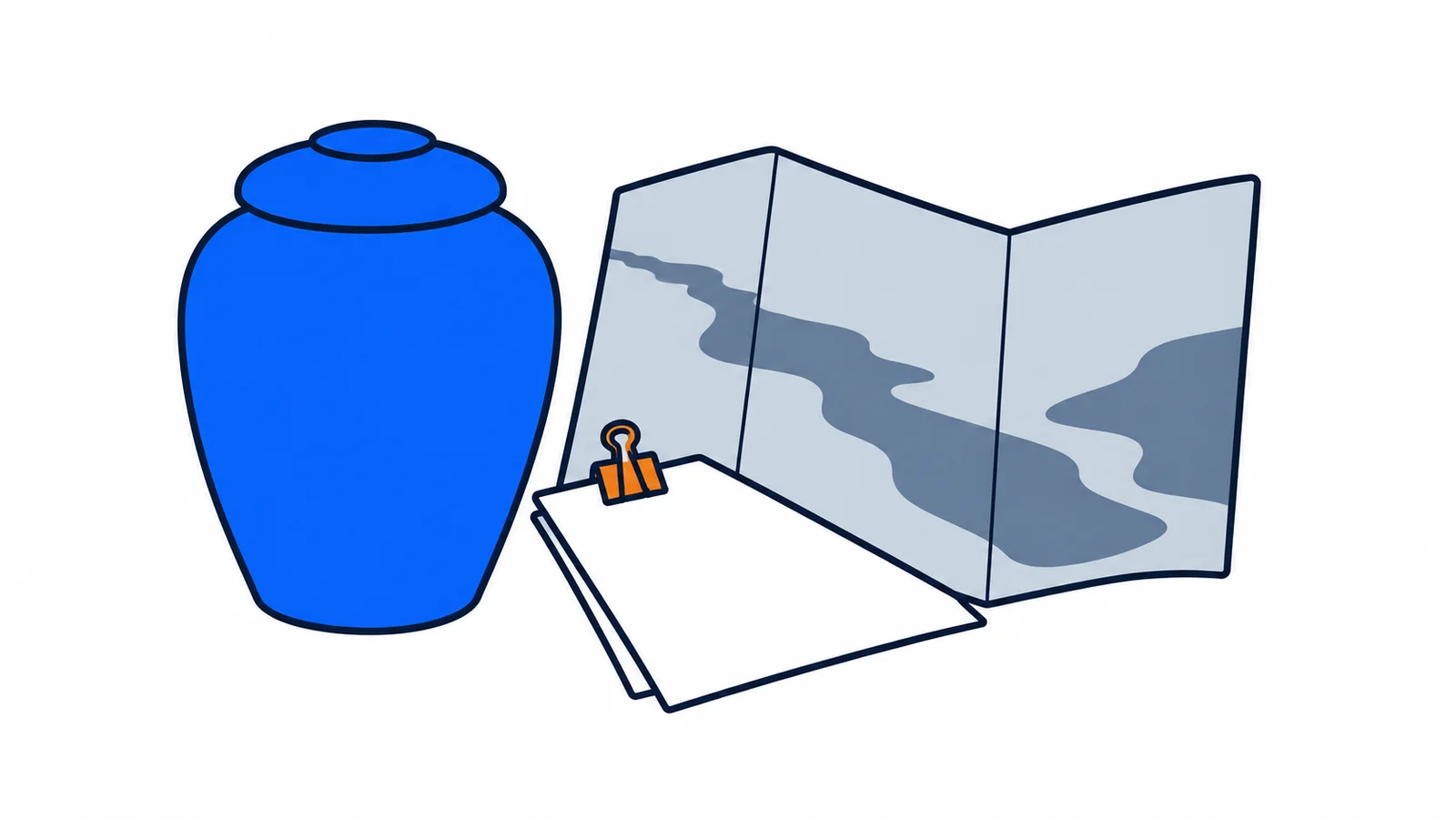

You need permission from Statsforvalteren, the County Governor, before scattering a deceased person’s ashes in nature. Apply in the county where you wish to scatter them. Clearly describe the location and the deceased’s wishes. Read the conditions, deadlines and any subsequent notification requirements before making practical plans.
What does choosing to scatter ashes mean?
Scattering ashes is an alternative to burying an urn. It means the family will not have a grave containing the ashes in a cemetery.
Barne- og familiedepartementet, the Ministry of Children and Families, explains the rules on scattering ashes. With this choice, the deceased’s name and details cannot be placed on a cemetery memorial. The ashes also cannot be divided between several locations or between scattering and burial.
Discuss what this choice means before applying. If someone in the family wants a particular grave to visit, clarify this early. Do not plan to scatter some of the ashes and keep the rest for another arrangement.
This guide covers applications to scatter ashes in Norway, excluding Svalbard. The information was checked on 2 November 2026. SamfunnPrep’s article index has more explanations of Norwegian services.
Who can apply for permission?
You can apply for yourself once you have turned 15. This allows the matter to be settled during your lifetime. Tell those closest to you where the application and any decision are stored.
If the person has already died, the person arranging the funeral can apply. They must show that it is likely the deceased wanted their ashes scattered. The family’s own preference is not the same as evidence of the deceased’s wishes.
A written statement can make those wishes easier to document. If there is no such statement, ask Statsforvalteren what information they need to assess the case. Do not say the deceased signed something if you only remember a conversation.
Permission may also be granted for a child’s ashes when the closest bereaved relatives wish it. If there is disagreement, seek guidance before deciding on the arrangements.
How do you choose a suitable location?
The character of the area matters. A location is not automatically approved because the family owns the land or has fond memories there.
The ministry’s circular on scattering ashes allows more types of natural setting than just high mountains and the open sea. Remote forest areas may be suitable. So may fjords, rivers and freshwater areas that are sufficiently secluded.
Areas near buildings, the family cabin, popular recreation spots or beaches are normally unsuitable. Heavy recreational traffic may also count against permission. Special restrictions may apply in protected areas.
Describe more than the name of the fjord or mountain. Show the specific area and how it is used. A photograph can make the description clearer, but does not replace the information required in the application.
If you are considering lowering the urn into the sea, clarify this in the application and with the crematorium. An urn made of readily dissolving material may be used as a form of ash scattering. Do not assume every urn is suitable.
What should you prepare before applying?
Prepare an overview of the person, their wishes and the location. Statsforvalteren’s guidance on application contents includes advice on a sketch map. The guidance uses the former name Fylkesmannen. Use the current form and requirements of the Statsforvalteren office handling the case.
| What to prepare | Why is it useful? |
|---|---|
| Who the application concerns | It must be clear whether you are applying for yourself or following a death. |
| Information about the deceased’s wishes | Statsforvalteren must be able to assess whether these were the deceased’s wishes. |
| A map and precise location description | Show the area in relation to buildings and, at sea, its distance from land. |
| A possible alternative location | This gives you something to discuss if the first choice cannot be approved. |
| Contact details | The caseworker must be able to request missing information. |
Giving an alternative location does not mean the ashes can be divided between the locations. Clarify which location the permission covers.
If you have an old permit, find the whole decision and any attachments. The location may have changed since approval, for example because the area has been developed.
How do you submit the application?
Use the ash-scattering application service in Altinn. It covers applications for yourself and on behalf of others, and requires login with electronic ID.
Send the application to Statsforvalteren in the county where you wish to scatter the ashes. This is not necessarily the county where you live or where the cremation takes place.
If you cannot use the digital service, contact the relevant office and ask for another way to submit your application. Also ask how to send personal information and attachments securely.
Keep a copy of what you send. If you are asked for further information, answer specifically and give the case number. Submitting an application is not the same as receiving permission.
What should you do when the decision arrives?
Read the whole decision before booking transport or setting a date. Statsforvalteren’s cemetery guidance, Gravplassveilederen, explains that permission may include conditions, including the location and how scattering is carried out. Changes to the area may require fresh approval.
Agree with the crematorium who may collect the urn, what documentation they need and which urn is suitable. This is a separate practical arrangement; the permission does not arrange collection for you.
Oslo municipality describes the procedures at Alfaset crematorium. Permission must be available before the urn is released. The municipality asks to receive it as soon as it is granted, and no later than five months after the date of death. Oslo also refers to the six-month deadline for burying an urn and asks you to make contact if you need an extended collection deadline, for example because of the weather.
This is a specific example of why you should contact the crematorium early. Do not treat the five-month procedure as a nationwide application deadline. Follow the deadlines in the decision and agree storage and collection with the place holding the urn. A request for more time does not automatically grant an extension.
What must you do after scattering the ashes?
Check in advance whether you must notify anyone, whom to notify and which signatures are required. Do not rely on general advice that nobody needs to be informed.
The current guidance from Statsforvalteren in Vestfold and Telemark requires notification of the time and place, signed by two witnesses. The page was checked directly on 2 November 2026. Read the requirements for your own permit, and also clarify whether you need to report back to the crematorium.
Keep the decision and documentation showing that the conditions were followed. If an instruction is unclear, ask the office to explain it before scattering takes place.
If permission is refused, read the reasons and appeal guidance. The ministry states that decisions can be appealed, and that the appeal goes to the Statsforvalteren office that made the decision. Do not scatter the ashes while awaiting clarification. SamfunnPrep’s practical tools provide more ways to navigate Norwegian services.