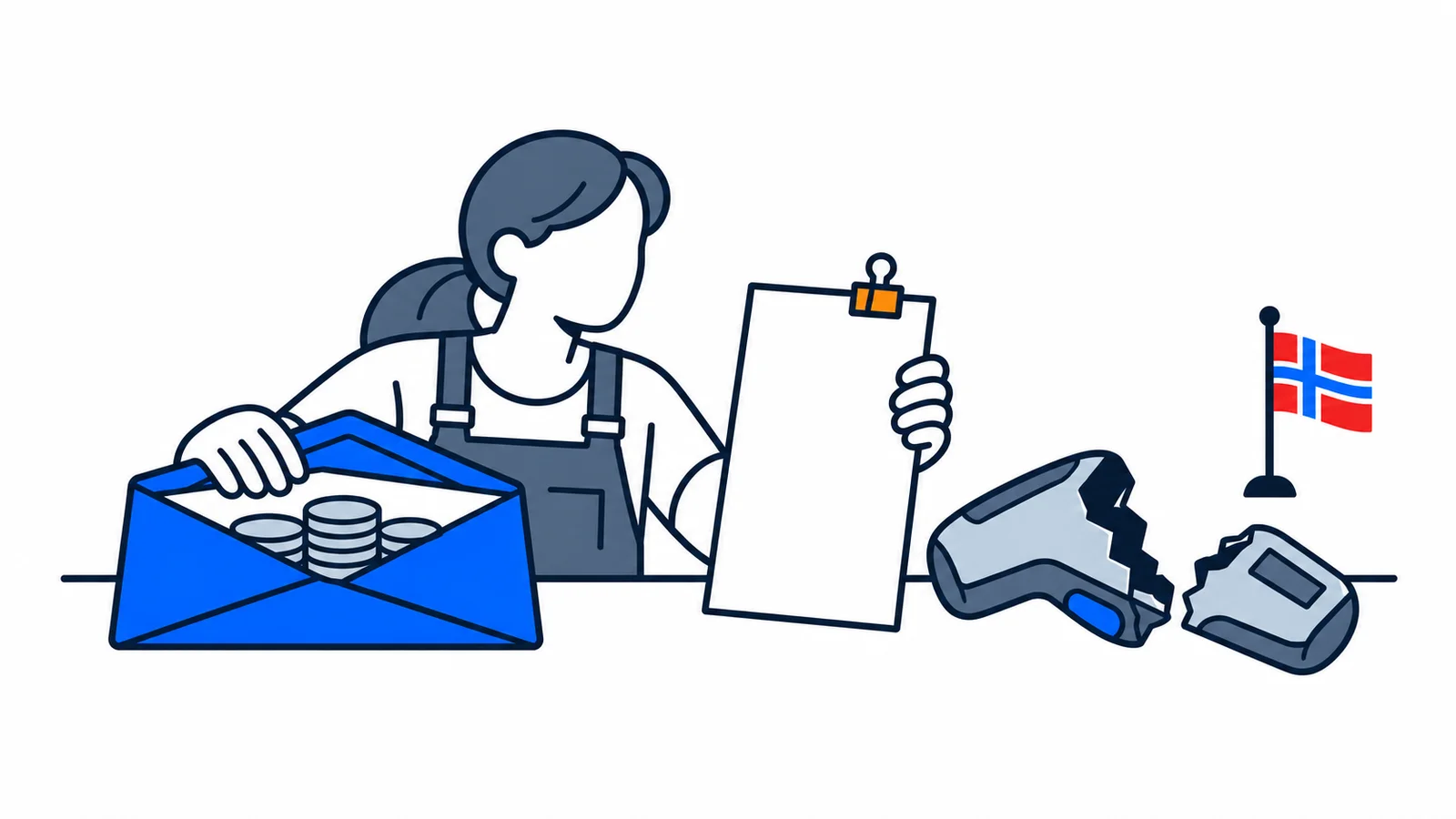

A deduction from wages needs a basis in law, a collective agreement or a valid written agreement. Tax withholding is a common deduction required by law. As a rule, an employer cannot decide alone to deduct overpaid wages or the cost of damaged equipment. Ask for an explanation before accepting the amount.
What may an employer deduct from wages?
§ 14-15 of the Working Environment Act sets the main rule: deductions must not be made from wages or holiday pay without a lawful basis. Some deductions are routine. Others require your consent to the specific situation. Always compare your payslip with your employment contract and the amount actually paid into your account. How to read your payslip explains gross wages, tax and net pay.
| Type of deduction | Typical basis | What you should check |
|---|---|---|
| Advance income tax withholding | Law and tax deduction card | Does the rate or table match your tax card? |
| Employee contribution to occupational pension | Exception in the Working Environment Act | Is this your agreed contribution, rather than the employer's share? |
| Trade union membership fee | Collective agreement or another valid basis | Are you covered, and is the amount correct? |
| Overpaid wages | Specific written deduction agreement | Have the reason, amount and repayment terms been agreed? |
| Damaged equipment | Specific conditions in law | Has liability for intentional damage or gross negligence been admitted in writing or established by a court? |
The table is a checklist, not automatic permission. A union deduction, for example, must be based on the arrangement that actually applies at your workplace. An amount labelled “miscellaneous” on a payslip does not tell you what legal basis the employer is using. Ask for that in writing.
Is a general clause in the employment contract enough?
A general sentence saying that the employer “may make deductions for overpayment” is not enough on its own for a particular deduction. Arbeidstilsynet explains that the employer must also justify the deduction in the specific situation. For an overpayment, a written deduction agreement is normally needed in which you consent to the amount and how it will be repaid.
Ask for a calculation before signing. How much was actually overpaid? Is it a gross or net amount, which month does it concern and how will tax be handled? How will the earlier payslip and a-melding be corrected? You should be able to understand a repayment plan without guessing. If you have several jobs, check that the alleged error belongs to the correct employer.
A deduction agreement does not mean that the employer always has a right to the money. You may disagree about whether there was an overpayment, how much it was, or whether you had reason to think your pay was correct. In a dispute, a union or legal adviser can help you assess the claim. SamfunnPrep also has information about trade unions and their role at work.
Can an employer deduct pay for damage or a mistake?
An accident at work does not automatically entitle the employer to deduct wages. The Working Environment Act allows deductions for damage or loss caused to the business intentionally or through gross negligence when liability has been admitted in writing or established by a judgment. The Act also has a special rule for an employee who unlawfully leaves the position. These are narrow situations, not a general rule that employees pay for everything that breaks.
Before a deduction under the damage provision, the employer must discuss the basis and amount with you and your employee representative, unless you do not want a representative. Ask for a description of the incident, the cost and why the employer believes the legal conditions are met. Do not sign an admission just to get your wages paid. If you are unsure, ask for time to read the document and seek advice.
Other lawful deductions may follow from a government decision. A wage attachment ordered by the enforcement authorities is a different process from the employer's own claim for an error. Read how wage attachment works if the payslip shows a deduction ordered by the enforcement officer. Ask payroll which decision it is following, and contact the authority that ordered the deduction about the underlying claim.
How much may be deducted if you have agreed?
Even when a deduction under a written agreement is lawful, the employer cannot necessarily take the entire amount from one wage payment. § 14-15 of the Working Environment Act says deductions under certain exceptions must be limited to what remains after the amount you reasonably need to support yourself and your household. Arbeidstilsynet therefore notes that repayment can be spread over several pay periods.
Example: A payslip shows 40 000 kroner gross, 10 000 in tax withholding, 800 as an employee pension contribution and 1 500 kroner labelled “damaged equipment”. The employer must explain the basis for the 1 500 kroner. The tax and pension deductions do not make the equipment deduction lawful. If you agree on a valid deduction, you must also consider a repayment plan that takes account of necessary expenses. These figures are only an example; tax cards and agreements produce different amounts for different people.
A holiday deduction on a payslip is not necessarily an unlawful deduction under this rule. Many employers pay holiday pay in a fixed month and simultaneously deduct ordinary wages for the holiday weeks. This is an adjustment of pay during leave. Check how holiday pay is calculated and paid before treating such an entry as a penalty or repayment.
What should you do if a deduction looks wrong?
First, ask payroll for a written breakdown. The Working Environment Act requires a statement when wages are paid or immediately afterwards showing the pay calculation, holiday pay basis and deductions. Save your contract, payslip, bank statement and messages. Explain which deduction you dispute, and ask for a corrected payslip and back pay if there is an error.
Subject: Question about wage deduction for [month]
Hello. My payslip for [month] shows a deduction of [amount] kroner labelled [text]. Please explain the legal basis and calculation, and provide a copy of any agreement or decision. I did not consent to this specific deduction / I believe the amount is wrong because [brief reason]. Please reply in writing and correct the payment if the deduction has no valid basis. Kind regards, [name].
If you cannot agree, a union may assess the matter. Arbeidstilsynet can explain the rules, but an ordinary claim for unpaid wages is, as a rule, a matter of private law. The guide to claiming unpaid wages shows the next steps when an unlawful deduction has resulted in underpayment.
Sources checked on 2 October 2026: § 14-15 of the Working Environment Act and Arbeidstilsynet's guidance on pay. SamfunnPrep explains employment rules in its labour immigration topic hub; assess a specific deduction agreement using your own documents.