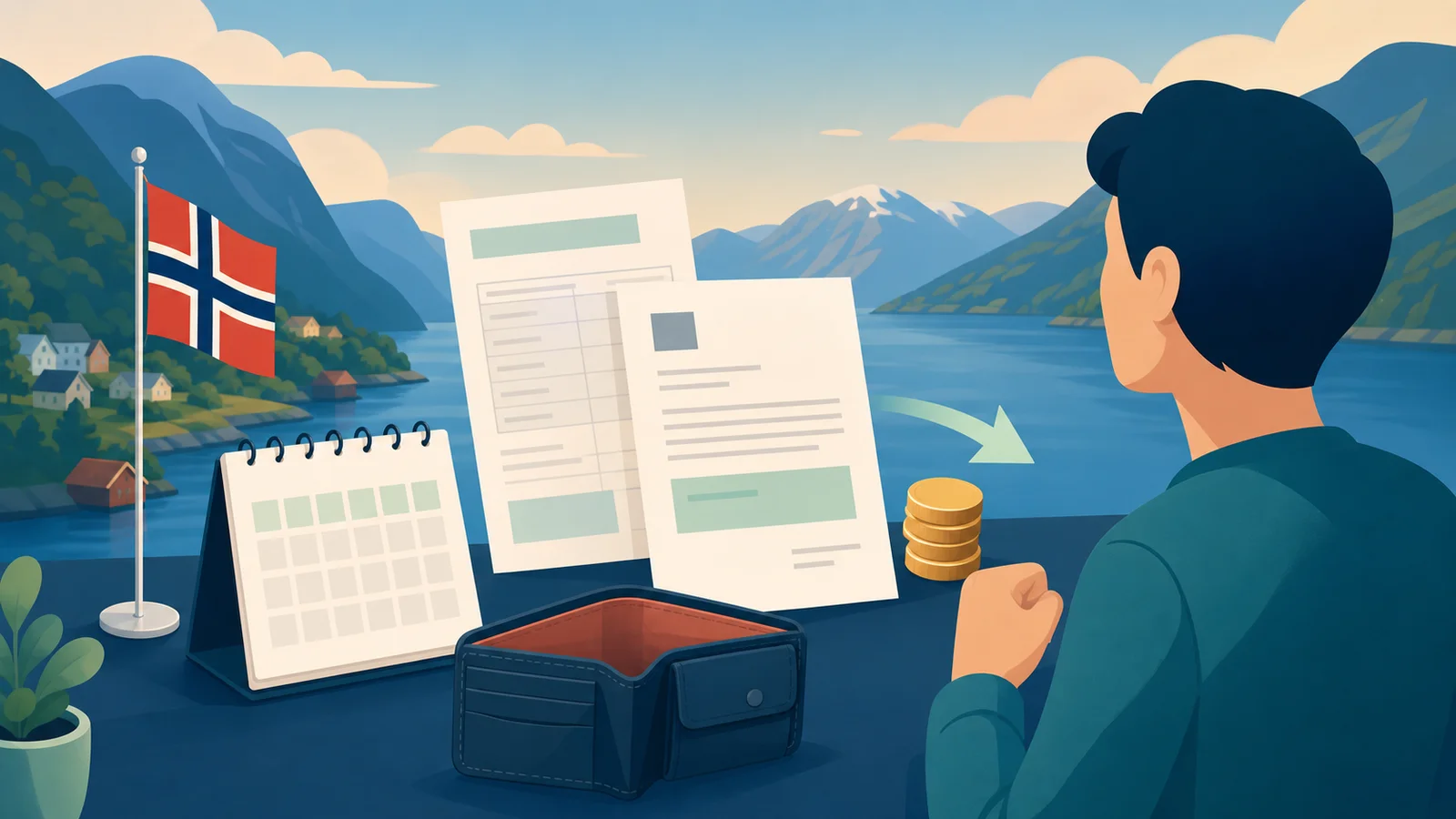


Undeclared work in Norway means that wages or payment is hidden from the authorities. This allows some to avoid tax. But the risk is significant: you can lose rights to sick pay and pension, and both employer and buyer can face back taxes and additional tax.
Norway builds its welfare state on tax. When work is not reported, society loses money for schools, healthcare and NAV. A person who works undeclared can also lose important rights when ill, injured or unemployed. This guide explains the rules in a simple way, so you know your rights and how to work legally.
What is undeclared work?
Undeclared work is work where income is not reported to Skatteetaten. Skatteetaten is the public agency that collects tax and maintains registers of income. The problem is not the method of payment, but that the income is hidden.
Payment can be made in cash, by card or via Vipps. A digital payment does not make the work legal by itself. What matters is whether tax, employer tax and value-added tax (VAT, a tax on goods and services) are handled correctly.
Undeclared work may seem harmless. A tradesperson offers a lower price without a receipt. A friend offers to clean, paint or babysit for cash. Then you get no documentation, warranty or security if something goes wrong, and you may contribute to workers being exploited.
In a legal employment relationship, you should have an employment contract, a pay slip and correct tax deduction. The employer reports the job to the authorities. These traces protect both you and society. If you want to understand the basis, you can read our guide on tax explained simply.
What risk do you take with undeclared work?
The risk is not just that the tax must be paid later. Skatteetaten can change your income, demand back taxes and impose additional tax. The standard rate for additional tax is 20 per cent of the tax you tried to avoid (as of 2026-07-08). In cases of gross evasion, enhanced additional tax may be imposed, so the consequence may be 40 or 60 per cent. Serious cases can become criminal matters.
Important: both the person who performs and the person who buys undeclared work can be held liable. If you buy a service undeclared, you are in a weaker position if there is damage, poor work or conflict. Without a receipt, it is difficult to complain, and insurance may not cover the damage.
The authorities can monitor both businesses and private individuals. They can compare bank transactions, reports and invoices. Therefore, think of undeclared work as a legal and economic risk, not as a discount.
This is labour crime, often called a-krim. a-krim is an offence related to wages, employment conditions, tax and benefits. Arbeidstilsynet, which is the agency for a safe working life, works against such crime together with the police and Skatteetaten.
The rights you can lose
When wages are not reported, many rights also disappear. Sick pay, unemployment benefits and pension are based on registered income. If the income disappears from the system, you may receive less money than you are entitled to.
Undeclared work often provides no occupational injury insurance. If you are injured at work, you may have no coverage. You can also lose evidence that the work was performed, and thus lose the right to correct wages, holiday pay and overtime pay.
Employees who are new to Norway may be pressured to accept undeclared wages. Some are told it is normal. That is not true. Documented income is often required when you apply for a loan, housing or a residence permit. Always ask for an employment contract and pay slip. Read more about employee rights and what should be in an employment contract.
Undeclared work also harms those who are serious. Companies that pay tax, wages and insurance have higher costs than those who cheat. When unscrupulous actors win contracts, the risk of social dumping and dangerous workplaces increases.
Legal or undeclared? Here's how you tell the difference
Not all cash payment is illegal. The boundary is whether income should be reported. The table shows the difference:
| Legal work | Undeclared work |
|---|---|
| Written contract and pay slip | Only verbal agreement |
| Income reported to Skatteetaten | Income hidden |
| Right to sick pay and pension | No registered rights |
| Invoice with organisation number | No receipt |
Small jobs in private homes can be tax-free. You can pay one person up to 6 000 kroner per year without tax, as long as the work is not part of that person's business activity (as of 2026-07-08). If you pay more, you must report it with a simplified employer notification. From a tax-exempt, voluntary organisation you can earn up to 10 000 kroner per year tax-free.
How to pay and work legally
It is easy to work legally. Demand documentation before the work starts, and pay in a traceable way. As a buyer or employee, you should ask for this:
- Written contract or invoice with organisation number
- Pay slip showing wages and tax deduction
- Payment via bank, card or Vipps to the company's account
- Receipt showing what you have paid for
Check your tax card and see if the income is included in the tax return. If you are unsure, you can contact Skatteetaten or Arbeidstilsynet before the problem grows. If you are considering working for yourself, the guide freelancer or sole proprietor explains how to do it legally.
Undeclared work and the civic knowledge exam
Labour law rules are part of the curriculum for the civic knowledge exam. The exam tests whether you understand how tax, welfare and working life are connected. You should be able to recognise typical situations: cash wages without a pay slip, lower prices without an invoice, or an employer who refuses to provide an employment contract.
Practice for free on SamfunnPrep, so you remember the words that often come up: tax, duty, employment contract, pay slip, rights and obligations. On SamfunnPrep you can practise real exam questions and see the answers explained. See also our tools for newcomers to Norway.
If you remember one thing, remember this: undeclared work may offer a lower price today, but high risk tomorrow.