

Short answer: You can receive unemployment benefits both when your employer terminates your employment and when you resign. If you resign without a reason accepted by Nav, you typically will not receive unemployment benefits for the first 18 weeks. However, you must still apply, register as a job seeker, and submit an employment status form.
The rules on this page were verified on September 12, 2026. Amounts based on the basic amount in the National Insurance Scheme may change on May 1 each year.
Terminated or Resigned?
| Situation | What can happen with unemployment benefits? |
|---|---|
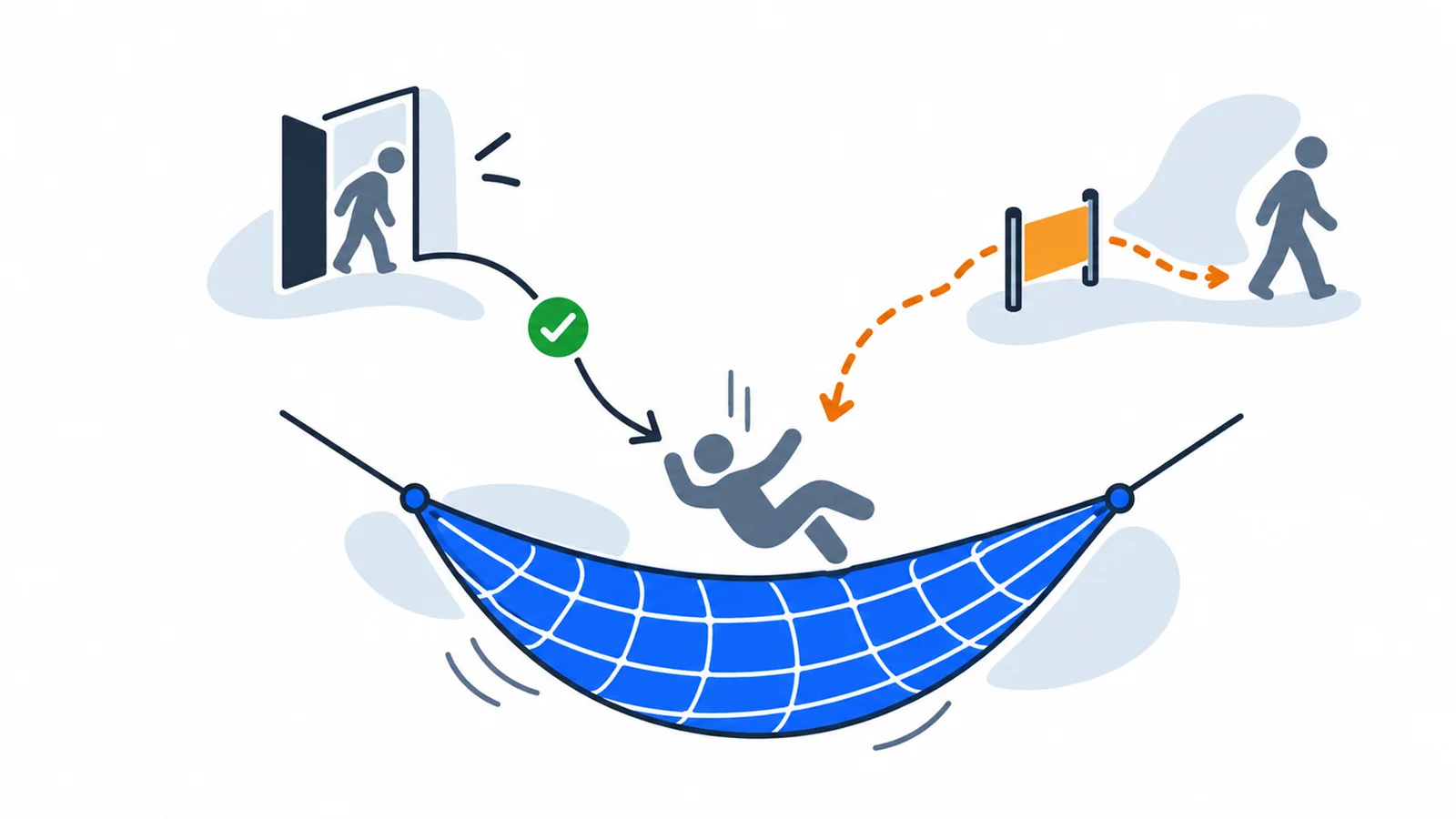
| Employer terminates your employment, and you are not at fault | You can receive unemployment benefits from the first day you are otherwise entitled |
| You resign with reasonable grounds | You can receive unemployment benefits from the first day you are otherwise entitled |
| You resign without reasonable grounds | No payment for the first 18 weeks |
| You are terminated or dismissed due to something you are responsible for | No payment for the first 18 weeks |
| You are laid off | Different rules apply; the employer typically pays wages for the first 15 working days |
“From the first day” does not mean that money will be in your account immediately. Nav must first process the application. Additionally, a deductible equivalent to three days of unemployment benefits will be deducted.
What Counts as Reasonable Grounds for Resigning?
Nav assesses the reason in each individual case. On its information page, Nav mentions, among other things:
- health challenges that prevent you from continuing in your job
- bullying or harassment in the workplace
You must be able to document the reason. A medical certificate, emails, incident reports, meeting minutes, or other written documentation may be relevant. What documents Nav requires depends on the case.
Do not decide for yourself that the reason is certainly good enough. It is Nav that assesses this after you have applied.
If you are considering resigning, it may be wise to talk to a doctor, union representative, safety delegate, or Nav first. Do not stay in an unsafe situation just to protect a potential benefit.
Main Requirements to Receive Unemployment Benefits
You may be entitled to unemployment benefits if all the main conditions are met:
- You have lost at least 50 percent of your total working hours.
- You have lost all or part of your income.
- You are under 67 years old.
- You normally reside in Norway and are a member of the National Insurance Scheme.
- You register as a job seeker.
- You submit an employment status form every 14 days.
- You are a genuine job seeker.
- You meet the income requirement.
If you have multiple jobs, Nav will consider the total working hours. You can find more practical help in the guide on registration as a job seeker and employment status form.
Income Requirement and G in 2026
The basic amount, often referred to as G, is 136,549 kroner from May 1, 2026.
| Limit | Amount | What is it used for? |
|---|---|---|
| 1 G | 136,549 kr | The basic amount |
| 1.5 G | 204,824 kr | Minimum income for the last 12 months |
| 3 G | 409,647 kr | Alternative minimum income for the last 36 months |
| 2 G | 273,098 kr | Distinction between up to 52 and 104 weeks |
| 6 G | 819,294 kr | Highest income included in the calculation |
Nav rounds 1.5 G to 204,824 kroner on the information page. You must have earned at least this in the last 12 months, or at least 409,647 kroner in total over the last 36 months.
Employment income, parental benefits as an employee, and certain other benefits can count towards the income requirement. Business income from sole proprietorships does not count in the same way. Nav has its own rules for freelancers and employees in their own limited companies.
How Much Can You Receive?
Unemployment benefits are 62.4 percent of previous income. Nav uses the income from the last 12 months or the average of the last 36 months and chooses the option that provides the highest payment.
Income over 819,294 kroner, or 6 G, is not included. A purely mathematical calculation of 62.4 percent of 6 G is approximately 511,239 kroner per year before tax. This is not a promise of your payment. Nav calculates daily rates, deductions, and employment status forms for each individual.
If you support children under 18 years old, you can receive 38 kroner per child per day, five days a week. Rules regarding where the child resides apply.
Unemployment benefits are taxable. Check your tax card if your income changes.
Deductible of Three Days
When you receive unemployment benefits, Nav deducts a deductible equivalent to three days of unemployment benefits. This is usually taken from the first payment.
If the first payment is too low, the remainder may be deducted later. You will not receive unemployment benefits until the entire deductible has been deducted.
This deductible is different from the 18-week period. You may be affected by both if you resigned without reasonable grounds.
How Long Can You Receive Unemployment Benefits?
- Income of at least 273,098 kroner, or 2 G: up to 104 weeks.
- Income below 2 G: up to 52 weeks.
- Recently discharged after at least three months in the military: up to 26 weeks.
Nav uses the income from the last 12 months or the average of the last 36 months and chooses the best option. Your decision will show how long you can receive benefits.
How to Apply Without Losing Days
- Apply about two weeks before your last day of entitlement to salary.
- Apply no later than the day you no longer have a right to salary.
- Register as a job seeker on the day from which you want entitlement.
- Upload your resignation and explain why the employment relationship ended.
- Submit any missing documentation within the deadline given by Nav.
- Send employment status forms every 14 days, even while you are waiting and during an 18-week period.
The earliest you can receive unemployment benefits is the day you have both applied and registered as a job seeker.
Nav indicated an expected processing time of seven weeks as of September 12, 2026. This is a snapshot, not a guarantee. When the application is approved, money is typically backdated from the day you were entitled, minus the deductible and other deductions.
See also SamfunnPrep's overview of Nav for those new to Norway.
Work While Receiving Unemployment Benefits
You can work and receive reduced unemployment benefits. If you work up to 50 percent of your normal working hours in an employment status form period, the payment will be reduced for the hours you report.
If you work more than 50 percent, you will not receive unemployment benefits for that employment status form period. If this happens for three employment status forms in a row, Nav will stop the case, and you will need to reapply if you later need unemployment benefits.
Report all hours correctly. Errors on the employment status form can lead to incorrect payments and demands for repayment.
Obligations While Receiving Unemployment Benefits
A genuine job seeker must, among other things:
- apply for jobs and attend interviews
- keep the CV updated
- be able to start at short notice
- as a general rule, accept various types of work anywhere in Norway
- be healthy enough to work at least 50 percent
- be available for Nav
There are exceptions in certain situations. State the need in the application and attach documentation if Nav requests it.
SamfunnPrep can help you understand words and themes from Norwegian work and society, but does not determine rights with Nav. If you want to practice simple Norwegian, you can try SamfunnPrep for free.